What's a Marker?
-
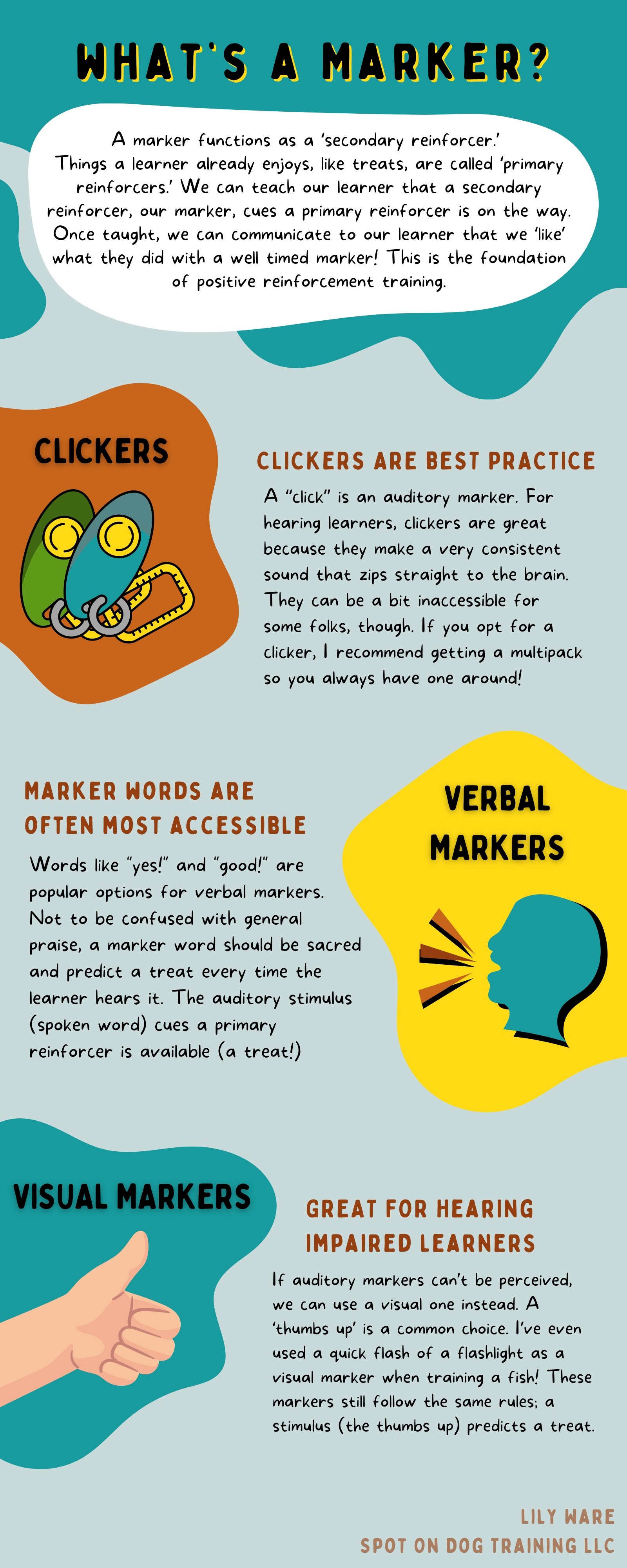
A light blue infographic with title “WHAT’S A MARKER?” at the top of the page. Beneath the title is a white bubble of text (see full infographic text below). Three large, colorful bubbles contain headings. Beside each bubble is a larger block of text explaining the heading. The bubble and text alternate left and right as you go down the page. The first bubble is in the top left of the page orange, reads “CLICKERS” and has a graphic of two clickers. Next bubble is yellow, reads “VERBAL MARKERS” and has a graphic of a head silhouette with lines coming from the mouth, indicating speech. The bottom bubble is teal, reads “VISUAL MARKERS” and has a graphic of a white person’s arm giving the ‘thumbs up’ sign.
-
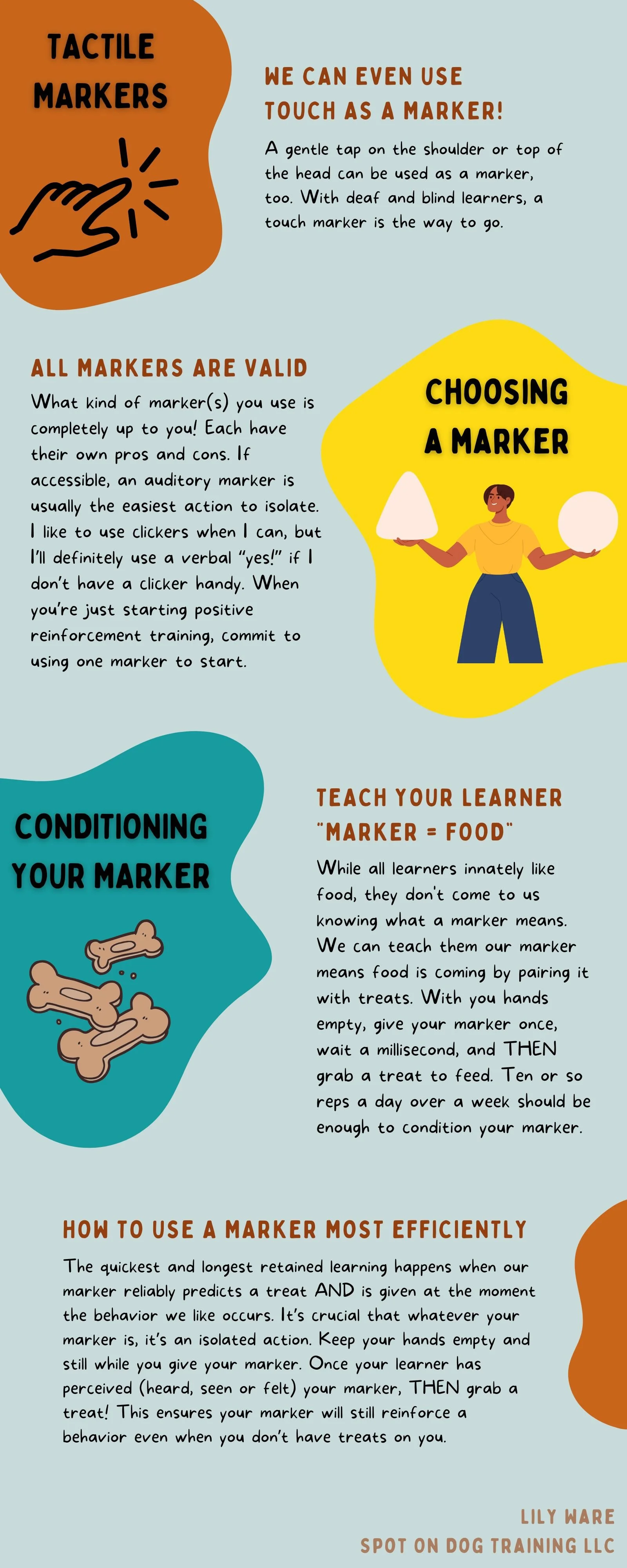
Second page follows the same format and colors as page one with alternating bubbles. In the top left corner is the first bubble. It reads “TACTILE MARKERS” and has a hand outlined with the pointer finger outstretched and lines extending from it, indicating touch. Next bubble reads “CHOOSING A MARKER” and has a graphic of a person standing holding both arms out. They appear to be weighing their options, with a white triangle in their left hand and a white circle in their right hand. The lowest bubble reads “CONDITIONING YOUR MARKER” and has a graphic of a few bone shaped dog biscuits. Finally, at the bottom of the page is a blurb of text.
-
WHAT’S A MARKER?
Things a learner already enjoys, like treats, are called ‘primary reinforcers.’ We can teach our learner that a secondary reinforcer, our marker, cues a primary reinforcer is on the way. Once taught, we can communicate to our learner that we ‘like’ what they did with a well timed marker! This is the foundation of positive reinforcement training.CLICKERS: CLICKERS ARE BEST PRACTICE
A “click” is an auditory marker. For hearing learners, clickers are great because they make a very consistent sound that zips straight to the brain. They can be a bit inaccessible for some folks, though. If you opt for a clicker, I recommend getting a multipack so you always have one around!VERBAL MARKERS: MARKER WORDS ARE OFTEN MOST ACCESSIBLE
Words like "yes!" and "good!" are popular options for verbal markers. Not to be confused with general praise, a marker word should be sacred and predict a treat every time the learner hears it. The auditory stimulus (spoken word) cues a primary reinforcer is available (a treat!)VISUAL MARKERS: GREAT FOR HEARING IMPAIRED LEARNERS
If auditory markers can’t be perceived, we can use a visual one instead. A ‘thumbs up’ is a common choice. I’ve even used a quick flash of a flashlight as a visual marker when training a fish! These markers still follow the same rules; a stimulus (the thumbs up) predicts a treat.TACTILE MARKERS: WE CAN EVEN USE TOUCH AS A MARKER!
A gentle tap on the shoulder or top of the head can be used as a marker, too. With deaf and blind learners, a touch marker is the way to go.CHOOSING A MARKER: ALL MARKERS ARE VALID
What kind of marker(s) you use is completely up to you! Each have their own pros and cons. If accessible, an auditory marker is usually the easiest action to isolate. I like to use clickers when I can, but I’ll definitely use a verbal “yes!” if I don’t have a clicker handy. When you’re just starting positive reinforcement training, commit to using one marker to start.CONDITIONING YOUR MARKER: TEACH YOUR LEARNER “MARKER = FOOD”
While all learners innately like food, they don't come to us knowing what a marker means. We can teach them our marker means food is coming by pairing it with treats. With you hands empty, give your marker once, wait a millisecond, and THEN grab a treat to feed. Ten or so reps a day over a week should be enough to condition your marker.HOW TO USE A MARKER MOST EFFICIENTLY
The quickest and longest retained learning happens when our marker reliably predicts a treat AND is given at the moment the behavior we like occurs. It’s crucial that whatever your marker is, it’s an isolated action. Keep your hands empty and still while you give your marker. Once your learner has perceived (heard, seen or felt) your marker, THEN grab a treat! This ensures your marker will still reinforce a behavior even when you don’t have treats on you.