
Our Methods
Why Force Free?

The science is clear and dog training is evolving.
We all experience enough stress already.
‘Force Free’ is what we strive for; I will never intentionally harm a learner or recommend you do.
I endorse and follow
the LIFE Approach
to Behavior Change
-
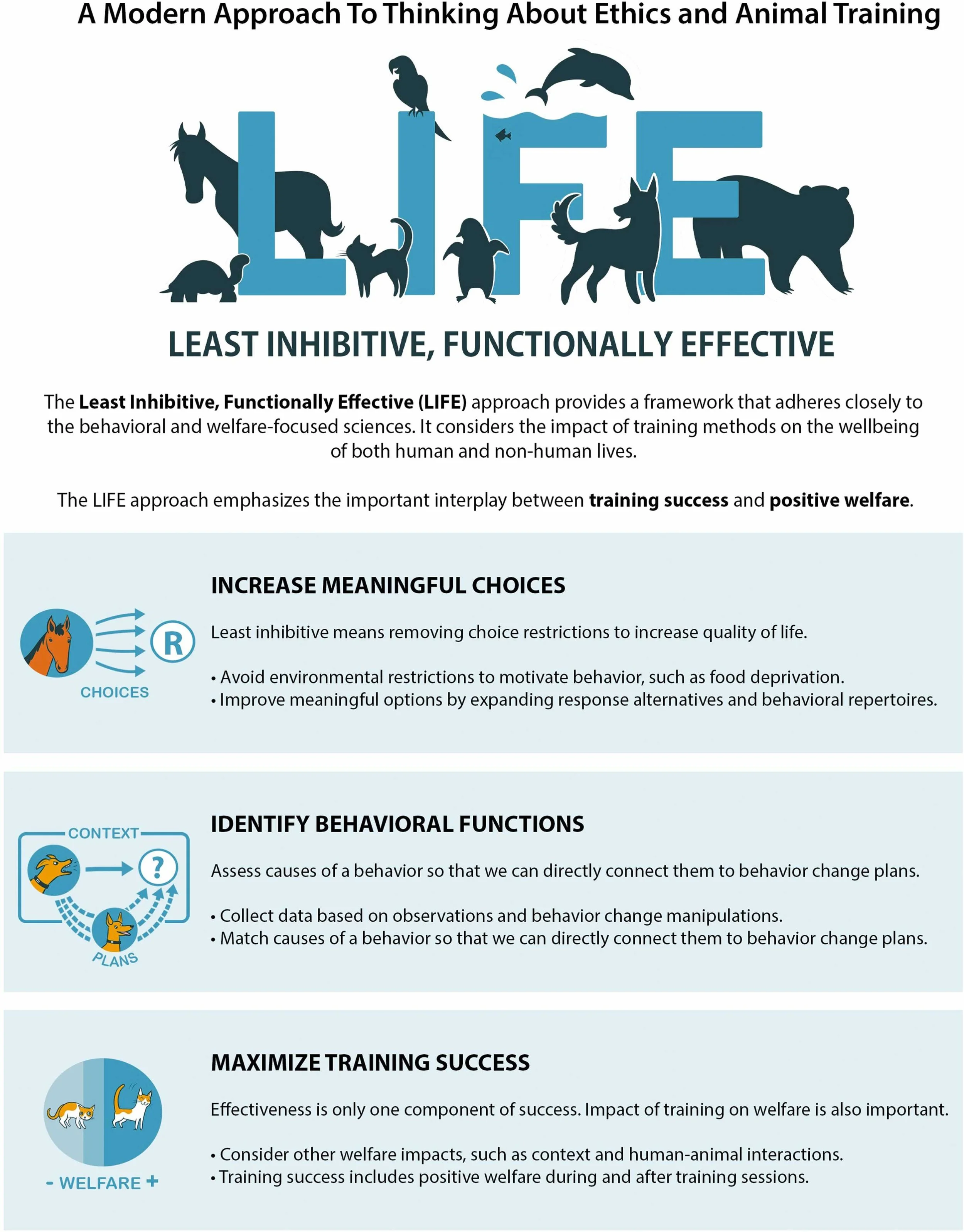
An infographic explaining the ‘LIFE’ approach to behavior change. The top of the page features a subheading reading “A Modern Approach To Thinking About Ethics and Animal Training.” Below that subheading is the title “LIFE: LEAST INHIBITIVE, FUNCTIONALLY EFFECTIVE.” Dark blue silhouettes of a turtle, horse, cat, parrot, penguin, dolphin, dog, and a bear are shown around “LIFE” both behind and in front of the text.
Under the title is a paragraph of text reading, “The Least Inhibitive, Functionally Effective (LIFE) approach provides a framework that adheres closely to the behavioral and welfare-focused sciences. It considers the impact of training methods on the wellbeing of both human and non-human lives.
The LIFE approach emphasizes the important interplay between training success and positive welfare.”
The bottom half of the page features three light blue rectangles.
The first blue box is titled “INCREASE MEANINGFUL CHOICES.” The left of the box shows a drawing of a horse with four arrows, labeled “CHOICES,” pointing to a circled “R.” The text in the box reads: “Least inhibitive means removing choice restrictions to increase quality of life. -Avoid environmental restrictions to motivate behavior, such as food deprivation. -Improve meaningful options by expanding response alternatives and behavioral repertoires.”
The middle blue box is titled “IDENTIFY BEHAVIORAL FUNCTIONS.” The left of the box shows a drawing of a dog barking, with an arrow pointing from the dog to a circled question mark, contained within a blue outline labeled “CONTEXT”. Below the context box are three curved dotted line arrows pointing to the question mark. The dog is drawn happy by these dotted arrows and labeled “PLANS.” The text in the box reads: “Assess causes of a behavior so that we can directly connect them to behavior change plans. -Collect data based on observations and behavior change manipulations. -Match causes of a behavior so that we can directly connect them to behavior change plans.”
The bottom blue box is titled “MAXIMIZE TRAINING SUCCESS.” The left of the box shows a drawing of the same cat twice contained within a circle. The bottom of the circle is labeled “- WELFARE +” The cat on the left is depicted cowering, while on the right the cat looks pleased. The text in the box reads: “Effectiveness is only one component of success. Impact of training on welfare is also important. -Consider other welfare impacts, such as context and human-animal interactions. -Training success includes positive welfare during and after training sessions.”
According to the American Veterinary Society of Animal Behavior (AVSAB), evidence supports the use of reward-based methods for all canine training. AVSAB promotes interactions with animals based on compassion, respect, and scientific evidence. Furthermore, the Joint Standards of Practice in Dog Training has promoted science-based, humane, and ethical practices across the profession since 2018.
Reward-based learning offers the most advantages and least harm to the learner’s welfare. Research supports the efficacy of reward-based training in addressing unwanted and challenging behaviors.
There is no evidence that aversive training of any kind is necessary for dog training or behavior modification.
Additionally, studies have shown strong correlation between the use of punishment in training and long-term behavior challenges like:
aggressive behavior towards people and other dogs, and
anxiety related behaviors like avoidance and excitability.
Teaching with any kind or amount of punishment inhibits relationships and makes it more difficult to identify pain in dogs.
The risks associated with punishment far outweigh the benefits when we can achieve better results with positive reinforcement and welfare based training.
At Spot On Dog Training, I’m committed to using reward-based methods and humane training with every single dog I encounter. I will never use or recommend aversive collars like shock or "e" collars, beeping or spraying collars, slip leads, choke chains, or prong collars. I do not engage in or endorse yelling, scolding, hitting, or any kind of purposeful harm to a dog's physical or emotional welfare.