Loose Leash Walking
-
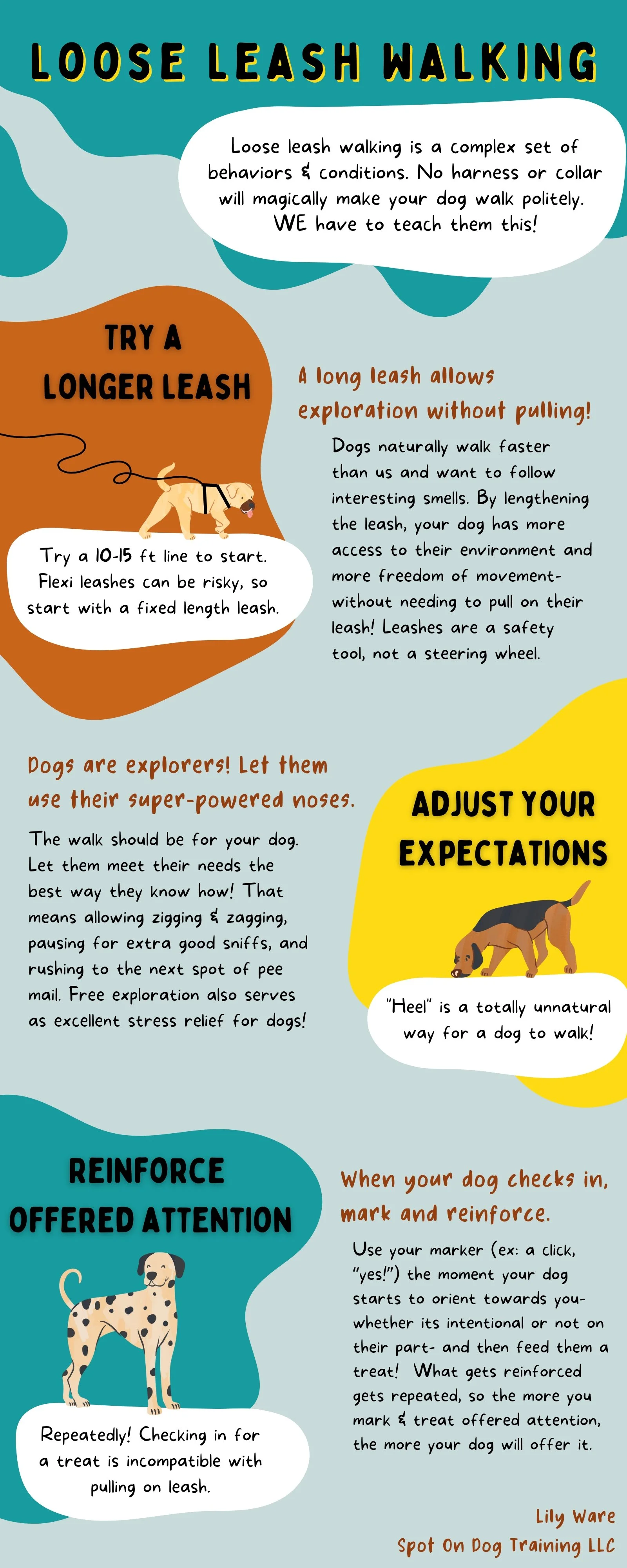
A light blue infographic with title “LOOSE LEASH WALKING” at the top of the page. Beneath the title is a white bubble of text (see full text below). Three large, colorful bubbles contain headings. Beside each bubble is a larger block of text explaining. The bubble and text alternate left and right as you go down the page. The first bubble is orange with a pug graphic on a long leash. Next bubble is yellow and shows a bloodhound sniffing the ground. The bottom bubble is teal and has a dalmatian graphic.
-
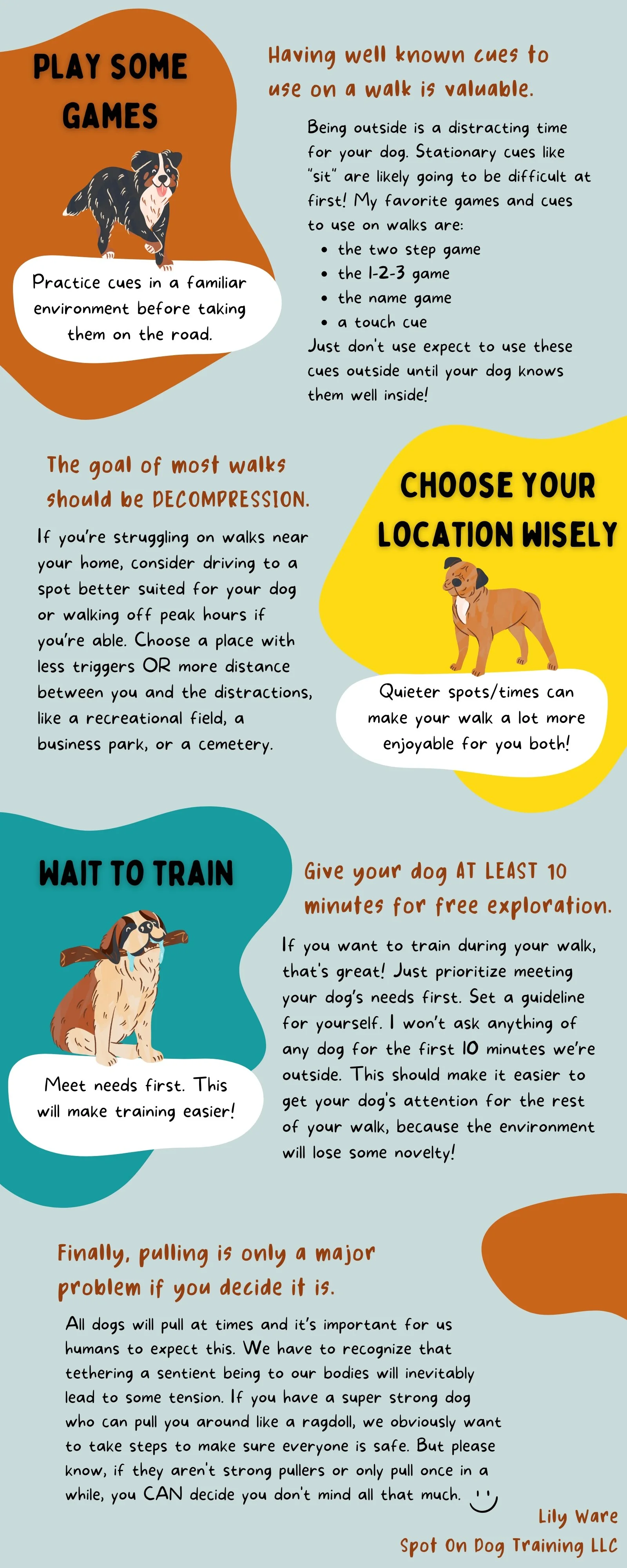
Follows the same format of colorful bubbles, alternating sides. The first bubble is orange with a Bernese mountain dog graphic. Next bubble is yellow and shows a boxer. The bottom bubble is teal and has a St Bernard holding a stick. At the bottom of the page is a larger body of text.
-
LOOSE LEASH WALKING
Loose leash walking is a complex set of behaviors & conditions. No harness or collar will magically make your dog walk politely. WE have to teach this!Try a longer leash. Try a 10-15 ft line to start. Flexi leashes can be risky, so start with a fixed length leash.
A long leash allows exploration without pulling! Dogs naturally walk faster than us and want to follow interesting smells. By lengthening the leash, your dog has more access to their environment and more freedom of movement- without needing to pull on their leash! Leashes are a safety tool, not a steering wheel.
Adjust your expectations. "Heel" is a totally unnatural way for a dog to walk!
Dogs are explorers! Let them use their super-powered noses. The walk should be for your dog. Let them meet their needs the best way they know how! That means allowing zigging and zagging, pausing for extra good sniffs, and rushing to the next spot of pee mail. Free exploration also serves as excellent stress relief for dogs!
Reinforce offered attention. Repeatedly! Checking in for a treat is incompatible with pulling on leash.
When your dog checks in, mark and reinforce. Use your marker (ex: a click, “yes!”) the moment your dog starts to orient towards you- whether its intentional or not on their part- and then feed them a treat! What gets reinforced gets repeated, so the more you mark & treat offered attention, the more your dog will offer it.
Play some games. Practice cues in a familiar environment before taking them on the road.
Having well known cues to use on a walk is valuable. Being outside is a distracting time for your dog. Stationary cues like "sit" are likely going to be difficult at first! My favorite games and cues to use on walks are:
the two step game
the 1-2-3 game
the name game
a touch cue
Just don't expect to use these cues outside until your dog knows them well inside!
Choose your location wisely. Quieter spots/times can make your walk a lot more enjoyable for you both!
The goal of most walks should be DECOMPRESSION. If you’re struggling on walks near your home, consider driving to a spot better suited for your dog or walking off peak hours if you’re able. Choose a place with less triggers OR more distance between you and the distractions, like a recreational field, a business park, or a cemetery.
Wait to train. Meet needs first.This will make training easier!
Give your dog AT LEAST 10 minutes for free exploration. If you want to train during your walk, that's great! Just prioritize meeting your dog’s needs first. Set a guideline for yourself. I won’t ask anything of any dog for the first 10 minutes we’re outside. This should make it a lot easier to get your dog's attention for the rest of your walk, because the environment will lose some novelty!
Finally, pulling is only a major problem if you decide it is.
All dogs will pull at times and it’s important for us humans to expect this. We have to recognize that tethering a sentient being to our bodies will inevitably lead to some tension. If you have a super strong dog who can pull you around like a ragdoll, we obviously want to take steps to make sure everyone is safe. But please know, if they aren’t strong pullers or only pull once in a while, you CAN decide you don’t mind all that much. :)
Lily Ware, Spot On Dog Training LLC