
When we tether a sentient being to ourselves,
WE HAVE to expect some pulling.
A harness’s job is simply to protect a dog’s body when there is inevitably tension on their leash.
I recommend dogs wear a well-fit, non-restrictive harness while on leash.
The goal is for your harness to allow the greatest possible freedom of movement while maintaining safety.
Freedom of movement is essential because an animal’s quality of movement is more important than the quantity.
An anatomically sound harness will protect your dog’s neck and body from the risks of sudden impacts while wearing a leash. Tension isn’t only caused by your dog pulling; our world is chaotic, and so much is out of our control! Leashes can get caught and pulled for any number of reasons.
-
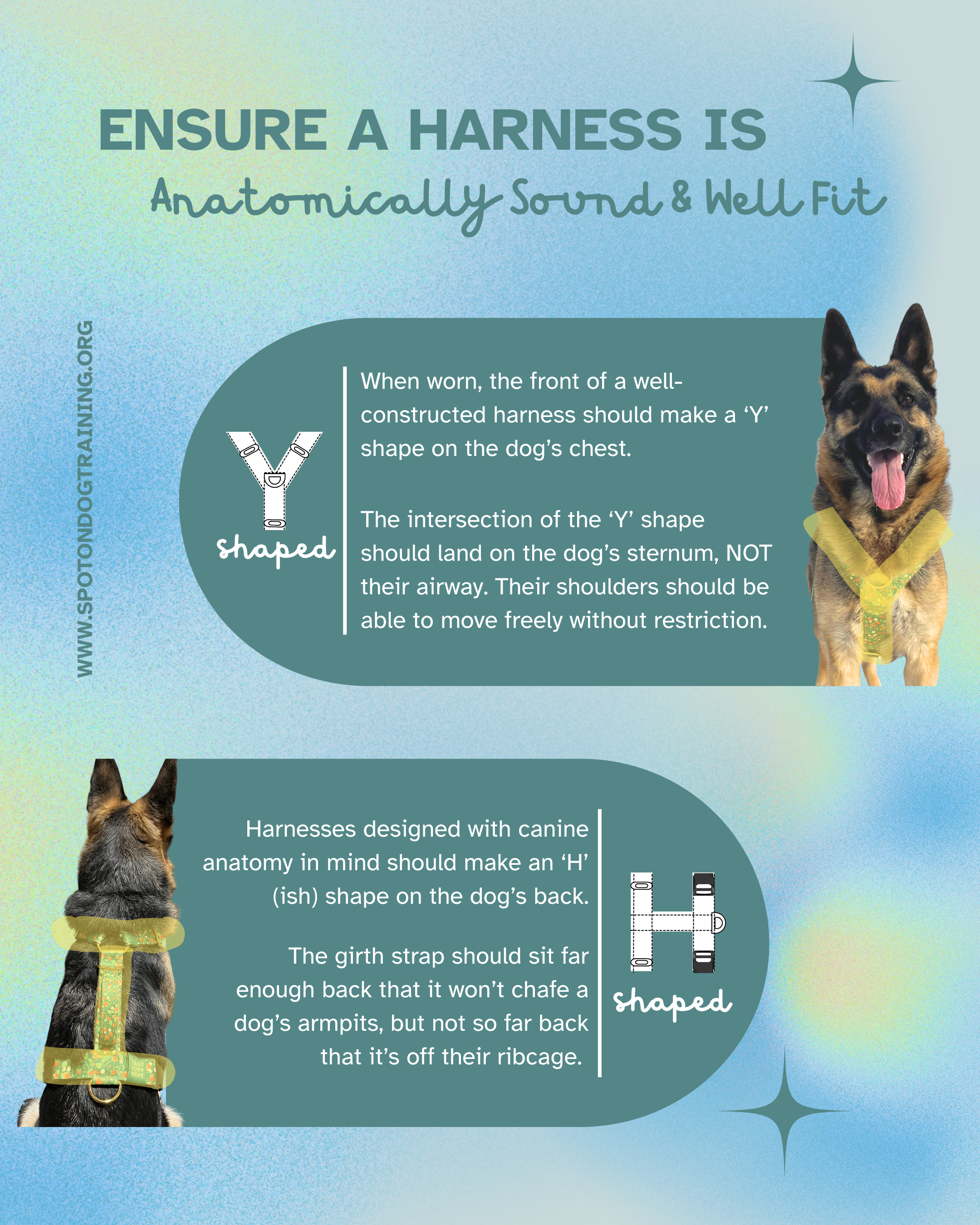
Title at the top of the image reads, “ENSURE A HARNESS IS Anatomically Sound & Well Fit”
“Anatomically Sound & Well Fit” is written in a script font.Below the title are two teal bubbles with text inside.
The first bubble is shifted to the right side of the page and features a large white “Y” with the text “shaped” beneath it on the left of the bubble. The Y has been drawn on to look like a harness. A photo on the far right of the bubble is a German Shepherd dog facing the camera, tongue out, wearing a harness. The shape of the harness is highlighted in yellow and forms a “Y.” In the middle of the of the bubble is white text reading,
“When worn, the front of a well-constructed harness should make a ‘Y’ shape on the dog’s chest.
The intersection of the ‘Y’ shape should land on the dog’s sternum, NOT their airway. Their shoulders should be able to move freely without restriction.”
Below the first bubble, the second bubble is shifted to the left side of the page and features a large white “H” with the text “shaped” beneath it on the right of the bubble. The H has been drawn on to look like a harness. A photo on the left of the bubble shows a German Shepherd dog sitting, facing away from the camera, wearing a harness. The shape of the harness is highlighted in yellow and forms a sideways “H.” In the middle of the of the bubble is white text reading,
“Harnesses designed with canine anatomy in mind should make an ‘H’ (ish) shape on the dog’s back.
The girth strap should sit far enough back that it won’t chafe a dog’s armpits, but not so far back that it’s off their ribcage.”
The background of the image is light blue, with scattered yellow auras. The text “WWW.SPOTONDOGTRAINING.ORG” is displayed sideways along the left side of the page. There are two teal, four-sided stars displayed in the top right and bottom right of the page.
Collars (flat, martingale, slip, chain, shock, electronic, spray, prong, etc.) and gentle leaders (head collars/halters, leashes wrapped around a dog’s nose or stomach) can cause significant discomfort, health problems, AND behavioral problems with long-term use.
Even many ‘anti-pulling’ harnesses are designed to be uncomfortable to pull in (to punish pulling), and long-term use can lead to arthritis and other shoulder issues.
Most ‘leash walking tools’ are designed to inflict pain when the leash is under tension, theoretically to punish the pulling behavior. If the tool did not hurt, it would not decrease pulling.
Linked is a short clip showing a dog walking, with its shoulder joint illustrated. The dog walks while wearing nothing, then in two different non-anatomical harnesses, then in an anatomically sound harness.

-
An infographic with a white background and black text illustrating a wrongly-fitted harness and a correctly-fitted harness.
Top Half of Page Title: “WRONGLY-FITTED HARNESS.” A dog is illustrated standing sideways, then sitting forward-facing. The dog wears a blue harness with the chest strap going perpendicularly across its chest.
Above the dog illustrated standing, the text “Girth strap is too tight; harness rubbing” points to the top of the girth strap, on the dog’s back. Below the dog, the text “Girth strap pushing into elbows” points to the dog’s armpit.
Next, the text “Too high on the neck” points to a strap that covers the sitting dog’s airway. “Too tight. Blocks shoulder extension and abduction” is the next text blurb that points to a strap going across the sitting dog’s chest.Bottom Half of Page Title: “CORRECTLY-FITTED HARNESS.” A dog is illustrated three times; once standing sideways, then sitting sideways twice. The dog wears a blue ‘Y’ or ‘H’ shaped harness.
The standing dog is directly below the title, with a text box to the left. This text reads, “Fit and adjust the girth strap of the harness first. Then adjust the chest and neck straps.” Blue text in all caps points to respective parts of the harness: “NECK STRAP, BACK STRAP, CHEST STRAP, GIRTH STRAP.” Below the standing dog are the two illustrations of the dog sitting sideways. The left illustration shows a human hand reaching under the neck strap. Text to the left reads “Keep the harness loose enough that 2-3 flat fingers can easily go under the neck and girth straps.” The right illustration is just of the dog sitting wearing the harness. Text reading “Girth strap is behind the elbows, though NOT behind the rib cage” points to the girth strap on this dog and the girth strap on the dog illustrated standing above.At the bottom of the page are two small lines of text. The first line reads “By Lori Stevens, CPDT-KA, SAMP, Senior Tellington TTouch Practioner Lori@SeattleTTouch.com” The next line reads “Illustrations by Lili Chin doggiedrawings.net”
Harness Recommendations
-
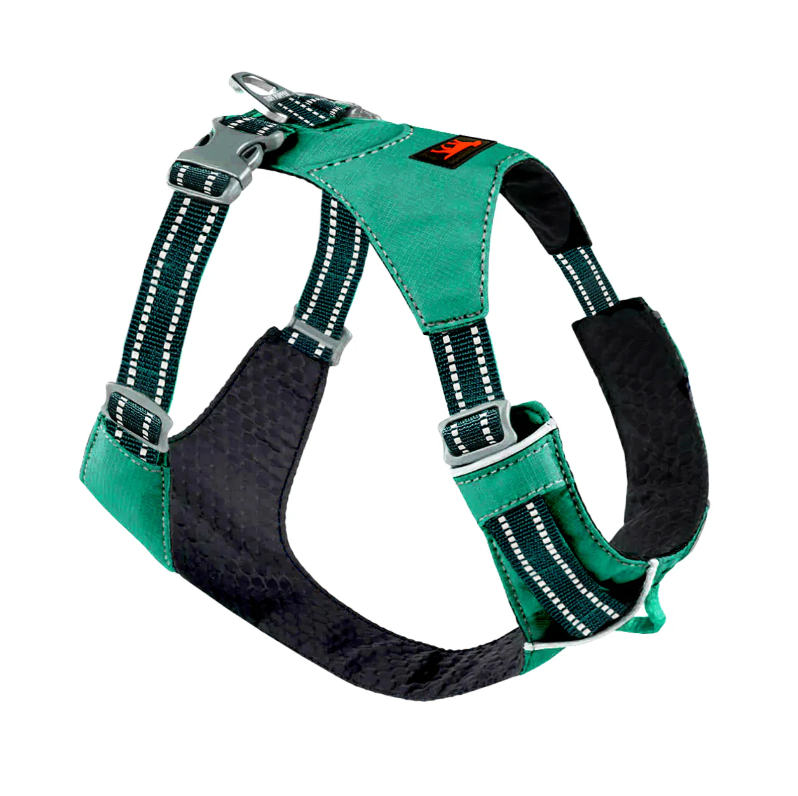
Trailblaze Lite Waterproof Harness
adjustable neck & girth straps
front & back leash attachment points
reflective trim
4 color options
fits girths 9-42 inches
-
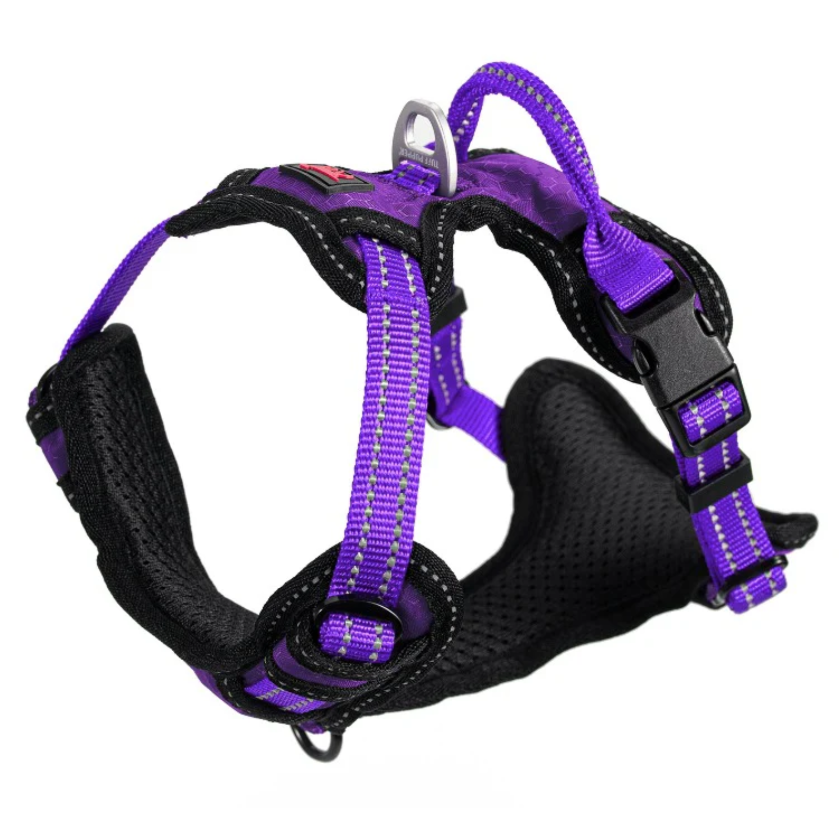
Metro Everyday Harness
adjustable neck & girth straps
front & back leash attachment points
a handle
reflective trim
5 color options
fits girths 14-35 inches
-

Zee.Dog H-Harness
adjustable neck & girth straps
2 back leash adjustments
60+ patterns
fits girths from 9-42 inches
-

Roman Dog Harness
adjustable neck, sternum & girth straps
back leash attachment point
½-, ¾-, or 1-inch strap width option
20+ patterns
fits girths from 9-44 inches
-
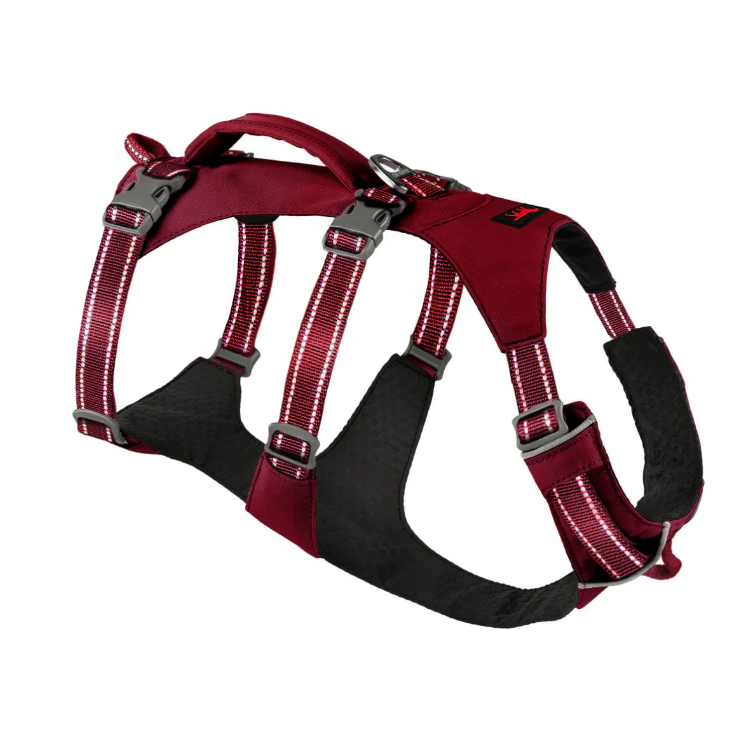
Trailblaze Harness
adjustable girth strap x2 & neck strap
front & 2 back leash attachment points
reflective trim
3 color options
a handle
fits girths 13-42 inches
excellent choice for flight risks & escape artists!
-
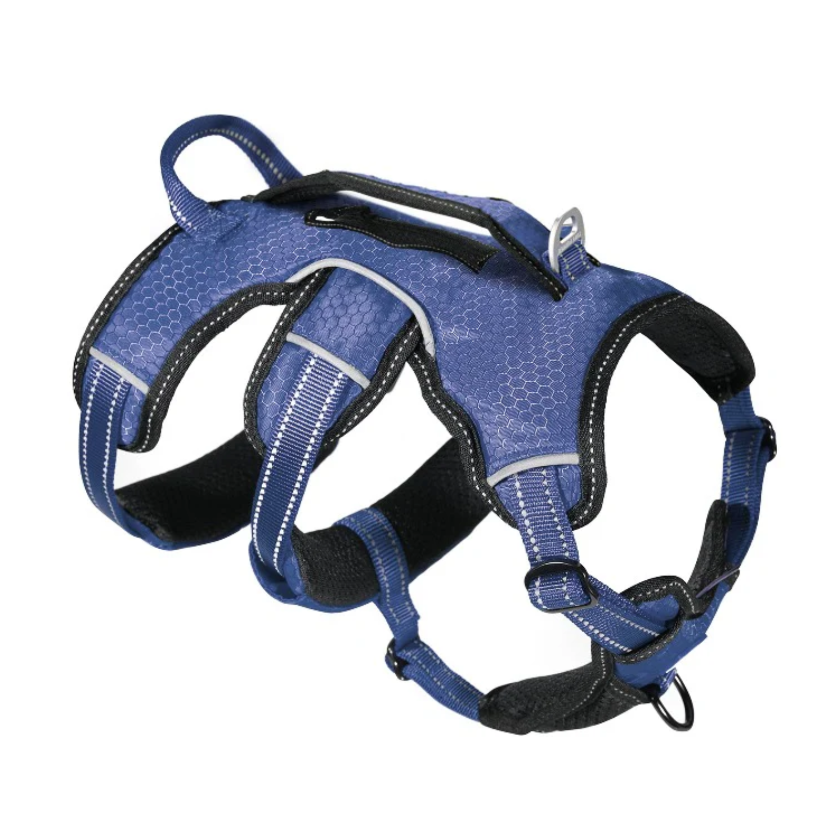
Tracker Rugged Harness
adjustable girth strap x2, neck, & sternum strap
front & back leash attachment points
2 handles
reflective trim
6 color choices
fits girths 13-40 inches
good choice for escape artists!
-
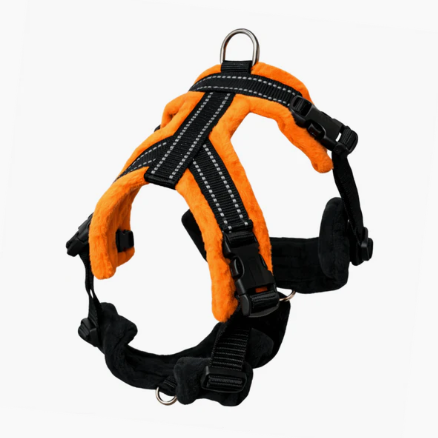
PerfectFit Harness
FULLY adjustable design w/ 3 individually sized pieces
5 points of adjustment
front & back leash attachment points
neck buckles
15-, 20-, or 40mm strap width options
14 color options
fits girths 9-48 inches
my first choice for gear-shy dogs
-

Hi & Light Lightweight Dog Harness
adjustable neck & girth straps
front & back leash attachment points
reflective trim
6 color options
fits girths 9-42 inches
-

Line Harness 5.0
adjustable girth strap
front (in larger sizes) & back leash attachment points
reflective trim
4 color options
excellent anatomical design
fits girths 11-44 inches
-

Comfort Walk Air Harness
adjustable neck & girth straps
a neck buckle
front & back leash attachment points
reflective stitching
10 color options
fits girths 13-45 inches
-

Front Range Harness
adjustable neck & girth straps
front & back leash attachment points
8 patterns
size up to avoid armpit chafing
fits girths 13-42 inches
-
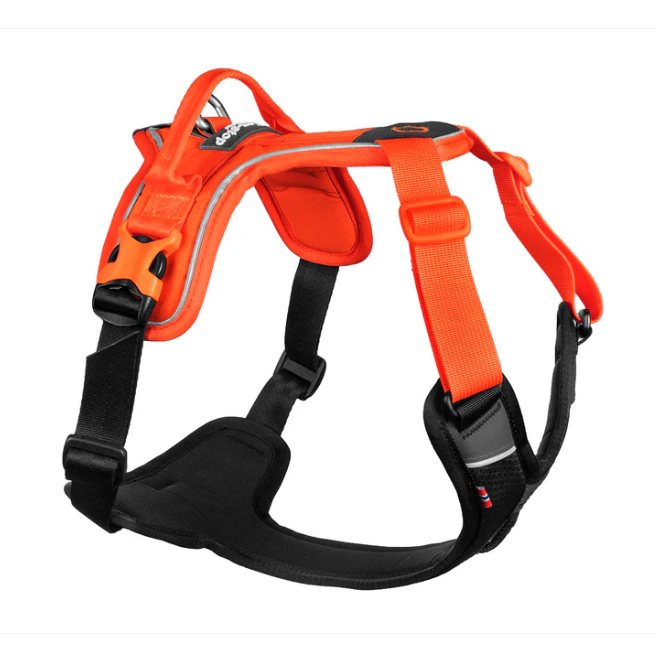
Ramble Harness
adjustable neck & girth straps
front & back leash attachments
a handle
reflective trim
4 color choices
fits girths 15.7-49.6 inches
-

Motion Harness
adjustable neck, girth, & sternum straps
front & 2 back leash attachment points
a padded handle
1- or 1.5” strap width choice
hardware color choice
70+ patterns
fits girths 24-44 inches
-

TRI-Harness
adjustable neck, girth & sternum straps
front & 2 back leash attachment points
only 1 buckle
15 colors to choose from
fits girths 19-35 inches
heavy
-

Flagline Harness
lightweight
adjustable girth strap x2 & neck strap
front & 2 back leash attachment points
reflective trim
a handle
6 color options
fits girths 13-42 inches
excellent choice for flight risks & escape artists!
-
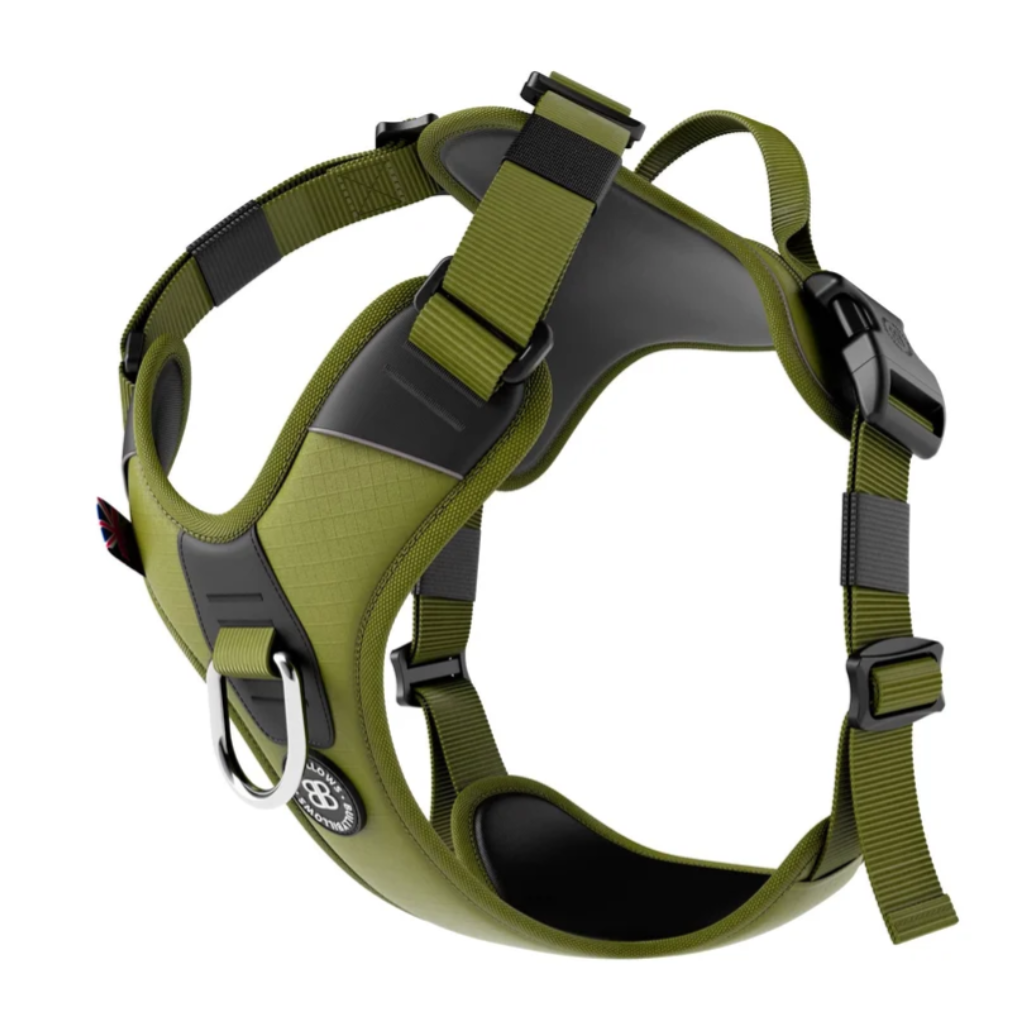
Hurricane Harness
adjustable neck & girth straps
front & back leash attachments
a handle
reflective trim
fits girths 11-50 inches
great choice for giant dogs!
-

Web Master Harness
adjustable girth strap x2 & neck strap
a neck buckle
front & 2 back leash attachment points
reflective trim
a handle
4 color options
fits girths 13-42 inches
good choice for escape artists!