Dog Body Language & Why it’s Important
Scroll down for Recommended Resources
Keeping your dog safe and happy starts with understanding their body language. While they may not speak our language, dogs are always trying to communicate through their movements and expressions! These (sometimes) subtle signals can tell us when they are excited, stressed, or uncomfortable. By learning to recognize these signs, we can step in before things escalate to help prevent conflicts and ensure our dogs have positive experiences. Whether they’re concerned about something or enjoying playtime, learning your dog’s cues allows you to advocate for their well-being and deepens your bond.
Dogs move fast, so practicing how to read their body language is essential to making it second nature. Try taking videos of your dog so you can slow them down and observe more closely. Keep the free e-book linked below open in a tab on your phone for easy reference. And don’t worry if you miss something—just keep paying attention and you’ll get better with time!
Examples of Interpreting Canine Body Language:
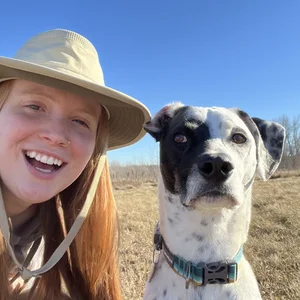
Using the ESTEEM framework (see the free Dog Body Language e-book linked below), we can decipher the following from foster dog Maybe’s body language in the video clip above:
Environment: External Environment- Our heated & attached garage. This is her first night in our care. Internal Environment- Maybe is experiencing hyperarousal & gastrointestinal distress (diarrhea).
She was also diagnosed with bilateral hip dysplasia AND a grade one luxating patella in her right knee three weeks after this clip. So, we can assume she’s experiencing significant musculoskeletal pain here, too.
Spine/Stance: Maybe’s spine is straight & her body is tense. She runs directly towards new/strong smells in the environment (me, the laundry room, the door, my car) while pacing about the room. Her weight is shifted forward & she is ready to change directions quickly.
Tail: The base of Maybe’s tail is held stiffly & up high. She wags the top half of her tail quickly, which indicates high arousal. Typically, her tail rests fairly low at the base & will wag with slow, wide swishes when she is happy.
Ears: Her ears are tensely held high & forward (which can indicate high arousal), unless she quickly swivels them towards sounds around her.
Eyes: Maybe looks around the room without blinking. Her eyes typically look directly at what she is approaching. We see some ‘whale eyes’ when she glances back at me as she runs around the room. Her brow is furrowed, which indicates stress.
Mouth: Her mouth is open & she is pulling her commissure (where the top and bottom lips meet) back into a tense “V” shape. Maybe’s tongue is tense, spatulate (hanging low w/ the end splayed like a spoon) & she has a large ‘tongue-to-tooth’ distance. We can see her premolars & she licks her lips several times without food around (indicating stress).
‘Maybe’ was STRESSED from meeting a new human and driving two hours with them to an unfamiliar place. Her tense, quick movements indicate high negative-valence arousal (anxious, frustrated, fearful).
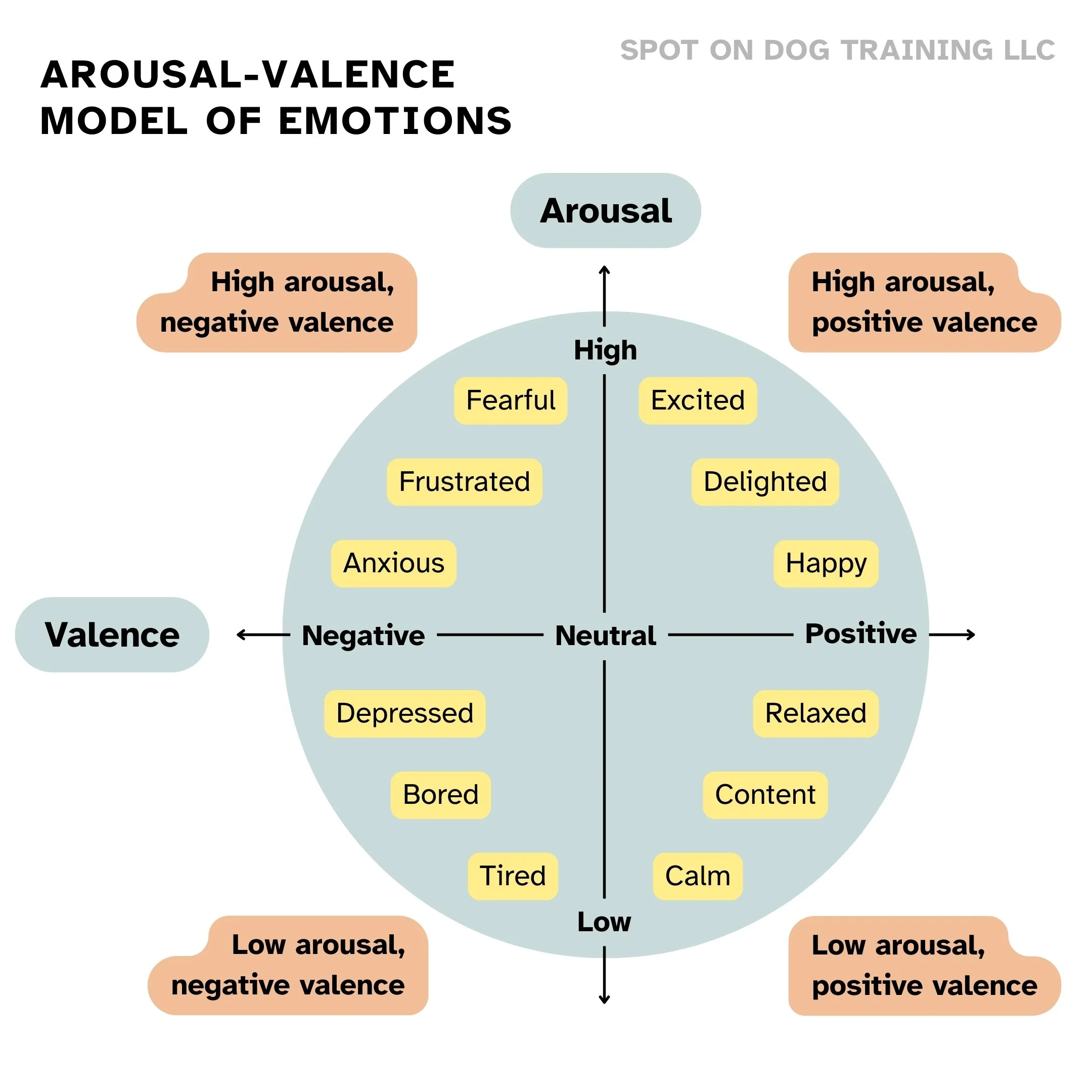
Arousal-Valence Model of Emotions
-
The title “AROUSAL-VALENCE MODEL OF EMOTIONS” is displayed in the top left of the image. A light grey watermark reads “SPOT ON DOG TRAINING LLC,” in the top right.
A graphic of a circle with a light blue background. Black lines, with arrows at both ends, go through the middle of the circle vertically (along the y axis) and horizontally (along the x axis).
The horizontal line, or x axis, is titled “Valence” to the far left outside the circle. Along this line within the circle, the leftmost reads “Negative,” the middle is labeled “Neutral,” and the rightmost is “Positive.”
The vertical line, or y axis, is titled “Arousal” above the circle. Along this line within the circle, the top reads “High,” the middle is labeled “Neutral,” and the bottom is “Low.”
Outside the top left quadrant of the circle is labeled “High arousal, negative valence” with a light orange background. Within the circle reads “Anxious, Frustrated, Fearful” with each word highlighted in light yellow.
Top right quadrant is similarly labeled “High arousal, positive valence.” Within the circle reads “Excited, Delighted, Happy” with each word highlighted in light yellow.
The bottom right quadrant is similarly labeled “Low arousal, positive valence.” Within the circle reads “Relaxed, Content, Calm” with each word highlighted in light yellow.
Finally, the bottom left is similarly labeled “Low arousal, negative valence.” Within the circle reads “Depressed, Bored, Tired” with each word highlighted in light yellow.
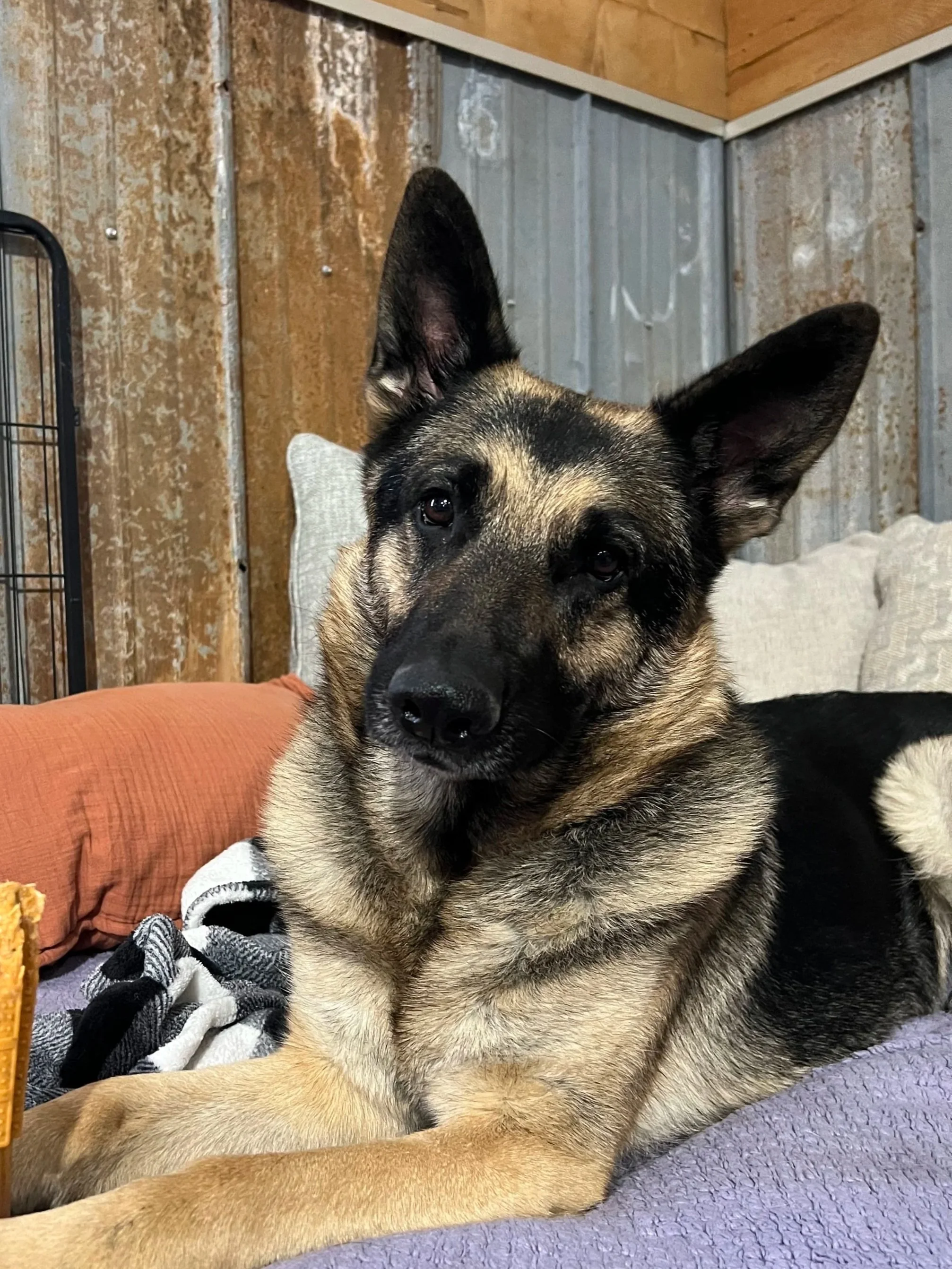
Compare Maybe’s body language in the video above
to hers in this photo.
E: External - In her ‘foster condo,’ (a gated off living room set in our attached garage). This was her 15th night with us & I was sitting beside her. Internal - GI & MSK pain.
S: She’s lying down & her spine is curved toward me.
T: Her tail is held loosely at the base & rests at her side.
E: Maybe’s eyes are soft & looking at me. Her brows are relaxed.
E: Maybe’s pointy ears are in their resting position. They sit farther apart & pointing a bit outward, indicating no tension.
M: Her mouth is closed & holds no tension.
‘Maybe’ was COMFY lying with me on the couch. Her relaxed muscles indicate low arousal with positive valence emotions (calm, content, relaxed).
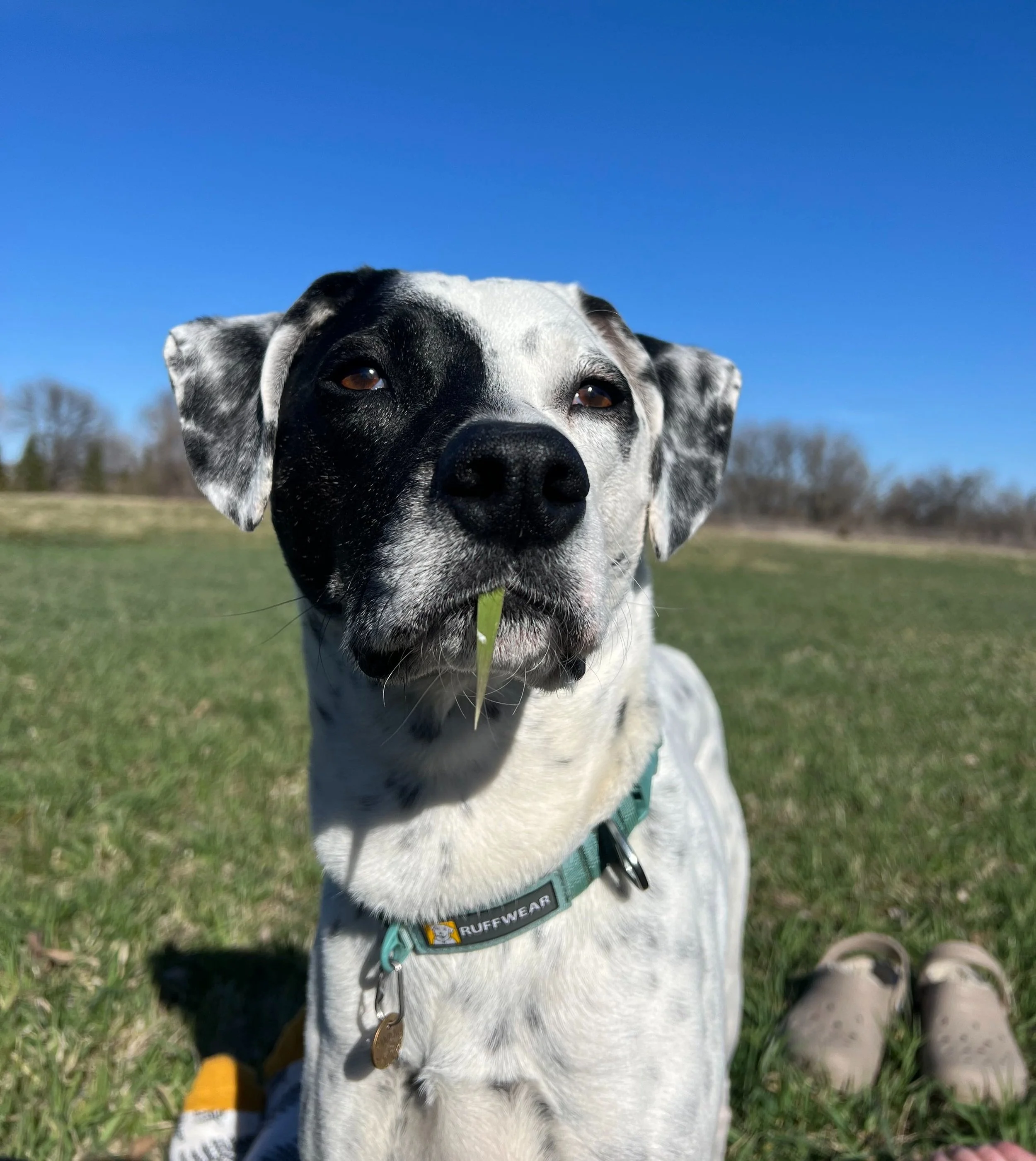
Now let’s interpret Randall’s body language the ESTEEM framework.
Environment: External- My spouse & I were in our yard with our dogs, Bertie & Randall, off-leash. We live in the country on an acreage. I wore a full treat bag. It was around 3 pm & warm. Internal- Randall was experiencing musculoskeletal pain related to his Intervertebral Disc Disease & arthritis.
Spine/Stance: Randall’s spine is straight & facing me, indicating an interest in moving towards me. His weight appears evenly distributed across all paws.
Tail: Randall’s tail is held loosely at the base & resting, similar to an “L” shape. This is his tail’s baseline height & how he typically holds it, suggesting comfort.
Ears: His ears are held up & pointed forward, signaling increased arousal (in this case, alertness). When relaxed, his ears sit a bit farther apart & lower, hanging loosely.
Eyes: Randall has soft, relaxed eyes & eyebrows with a slightly tense, wrinkled forehead. He is looking at the gravel road ~200 yards away. His pupils are naturally adjusted to the bright sunshine.
Mouth: His mouth is closed & facial muscles are relaxed. His commissure is “U” shaped (from the side), indicating little to no tension. He is not pulling or pushing his lips in any direction.
Randall is mostly RELAXED. He’s INTERESTED in the environment & potential treats. This snapshot is an example of medium arousal with a positive valence.
Recommended Resources
Doggie Language: A Dog Lover’s Guide to Understanding Your Best Friend by Lili Chin
This $12 book makes a great coffee table book and is easy to share with others, even kiddos!
Free "Green", "Yellow", & "Red" light play behaviors video by the Shelter Playgroup Alliance on YouTube
Checkout the Shelter Playgroup Alliance’s YouTube channel for more informative videos.
Free @up_2_snuff (Ali Sutch, KPA-CTP CCUI) on Instagram
Navigate to the highlight on “Play” at the top of their profile.
Virtual Webinars: Play It Cool and Cool It Down
If you have the time & resources, I highly recommend these $25/each webinars—they’re packed with valuable insights!

-
Atop the page, the title “Doggie Language” is displayed with the subtitle “starring Boogie the Boston Terrier” below it.
[a five by six array of various drawings of a black & white Boston Terrier showing different body language cues]
Line one reads “Alert, Suspicious, Anxious, Threatened, Angry”
Line two reads "Peace!" (look away/ head turn), Stressed (yawn), Stressed (nose lick), "Peace!" (sniff ground), "Respect!" (turn & walk away)
Line three reads "Need Space" (whale eye), Stalking, Stressed (scratching), Stress Release (shake off), Relaxed (soft ears, blinky eyes)
Line four reads, "Respect!" (offer his back), Friendly & Polite (curved body), Friendly, "Pretty Please" (round puppy face), "I'm Your Lovebug" (belly-rub pose)
Line five reads "Hello I love you! (greeting stretch), I'm Friendly! (play bow), Ready! (prey bow), You Will Feed Me"
Line six reads, “Curious (head tilt), Happy (or hot), Overjoyed (wiggly), "Mmmm....," "I love you, don't stop"
“2011 Lili Chin www.doggiedrawings.net” is displayed in the bottom right corner.
-
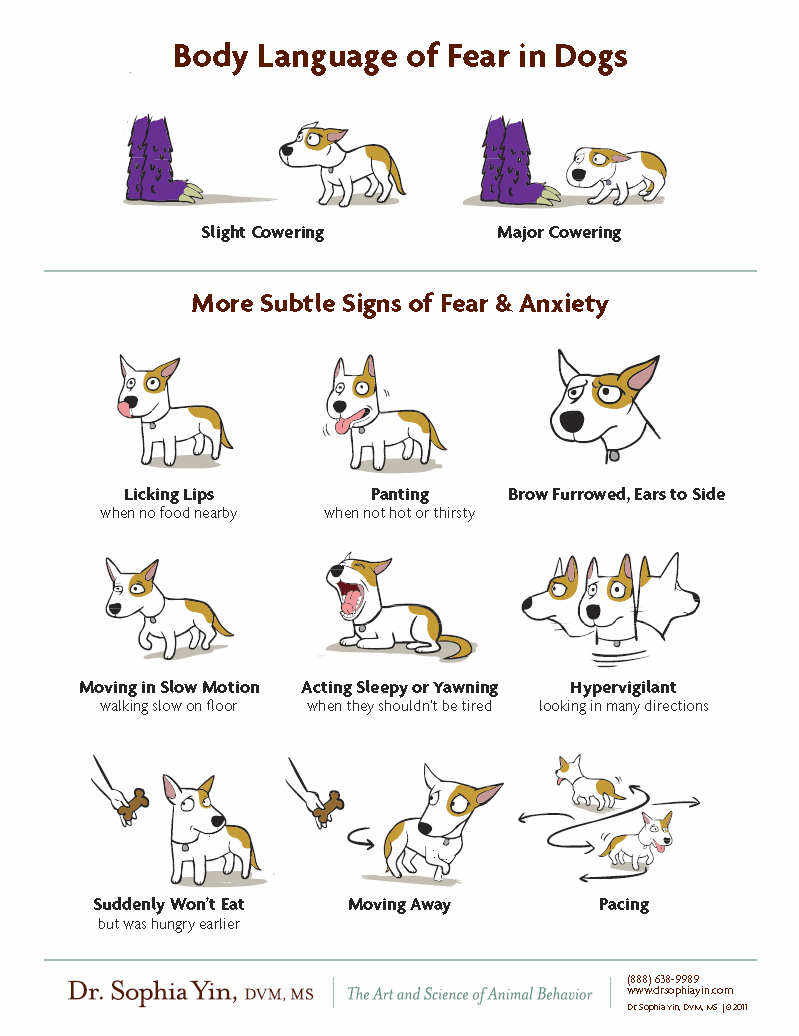
Atop the page the title reads “Body Language of Fear in Dogs”
Two subtitles below read, “Slight Cowering | Major Cowering”
Slight cowering shows the dog facing purple monster legs. The dog is crouched slightly with their tail held low and ears held back.
Major cowering shows the dog again facing purple monster legs. The dog is crouched low with their tail tucked between their legs and their ears flattened back.A green line divides the page before the next section.
Subheading: “More Subtle Signs of Fear & Anxiety”
[shows a three by three collection of drawings of a white dog showing the respective body language cues labeled below each dog]
Line one reads, “Licking Lips (when no food nearby), Panting (when not hot or thirsty), Brow Furrowed, Ears to Side”
Line two reads, “Moving in Slow Motion (walking slow on floor), Acting Sleepy or Yawning (when they shouldn't be tired), Hypervigilant (looking in many directions)”
Line three reads, “Suddenly Won't Eat (but was hungry earlier), Moving Away, Pacing”
Below another green line at the bottom of the page reads:
“by Dr. Sophia Yin, DVM, MS | The Art and Science of Animal Behavior | (888) 638-9989, www.drsophiayin.com, 2011”
-
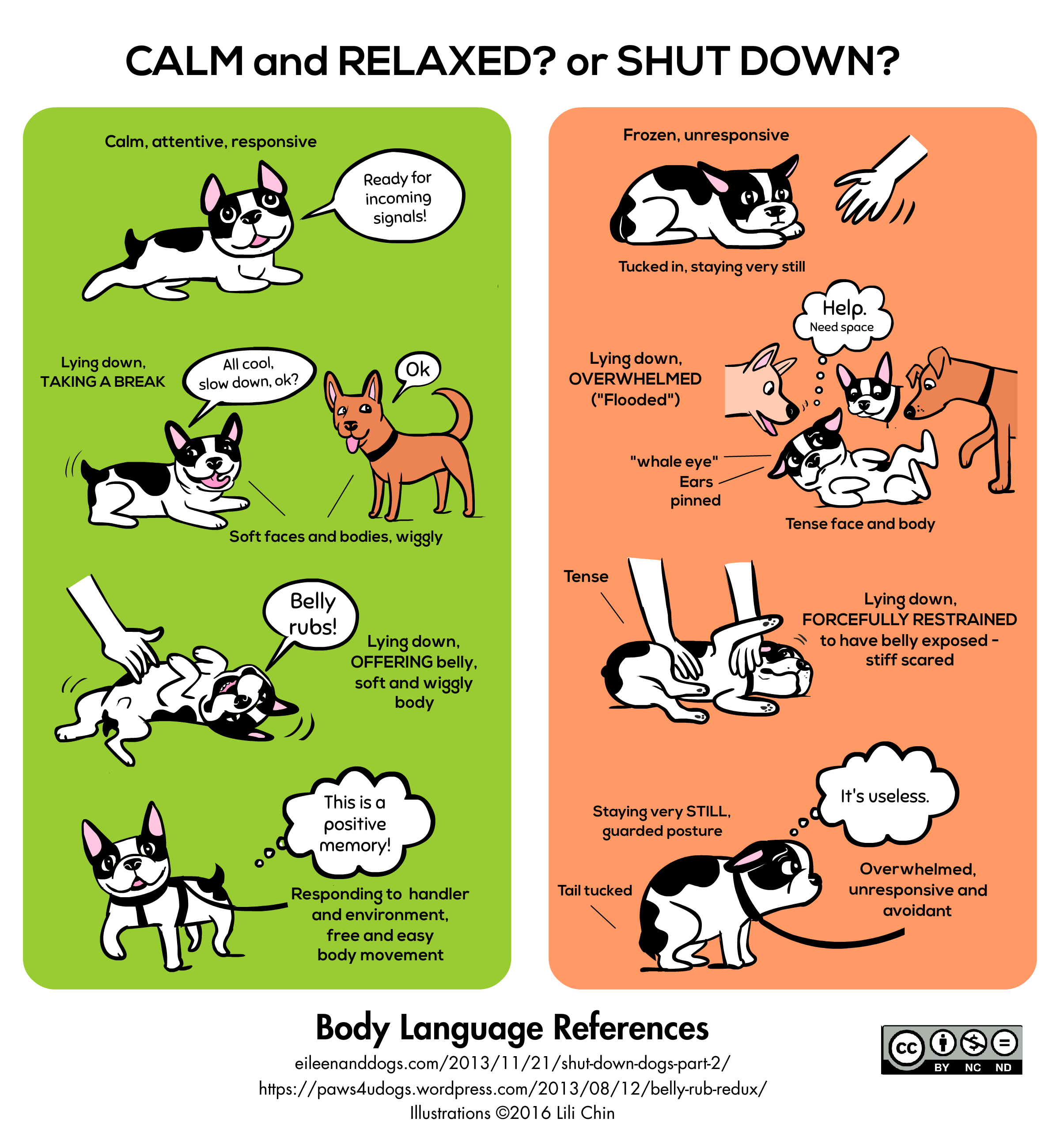
Atop the page the title reads “CALM and RELAXED? or SHUT DOWN?”
The left side of the page features a green box with drawings of dogs representing the captions inside.
The right side similarly has a light red box with more dog drawings.
From top to bottom, the captions in the green box read, “Calm, attentive, responsive.” Below this caption a drawing of a boston terrier is featured standing happily with a voice bubble reading “Ready for incoming signals!”
Next caption reads “Lying down, TAKING A BREAK” and shows the same boston terrier laying down with their tail wagging and a voice bubble “All cool, slow down, ok?” Beside the right of the terrier is a red dog standing, panting and looking away from the terrier with a voice bubble “Ok” Below the drawings of the dogs, another caption reads, “Soft faces and bodies, wiggly.”
Then we see the caption, “Lying down, OFFERING belly, soft and wiggly body” with the boston terrier laying on their back wiggling while a hand touches their belly. They have a voice bubble reading “Belly rubs!”
The last caption in the green box reads, “Responding to handler and environment, free and easy body movement.” The boston terrier is drawn on leash, wearing a harness with the thought bubble “This is a positive memory!”
From top to bottom, the captions in the light red box on the left of the page read, “Frozen, unresponsive.” A drawing of the boston terrier cowering with a hand reaching towards them is shown. Beneath the drawing, another caption reads, “Tucked in, staying very still.”
“Lying down, OVERWHELMED (‘Flooded’)” a boston terrier is lying on their back while surrounded by three other dogs that are leaning in and looking at them. They have a thought bubble reading, “Help. Need space.” Two small captions to the left of the boston terrier point at their head and say “whale eye,” and “Ears pinned.” Beneath the terrier a caption reads “Tense face and body.”
“Tense” points at a drawing of the boston terrier laying on their side with their legs stiffly outstretched as two hands touch the dog. The caption “Lying down, FORCEFULLY RESTRAINED to have belly exposed - stiff scared” appears to the left of this drawing.
Finally, we read “Standing very STILL, guarded posture, tail tucked” to the left of the dog drawn cowering while on leash. Their thought bubble reads “It’s useless.” and one more caption appears on the right of the dog, “Overwhelmed, unresponsive and avoidant.”
-
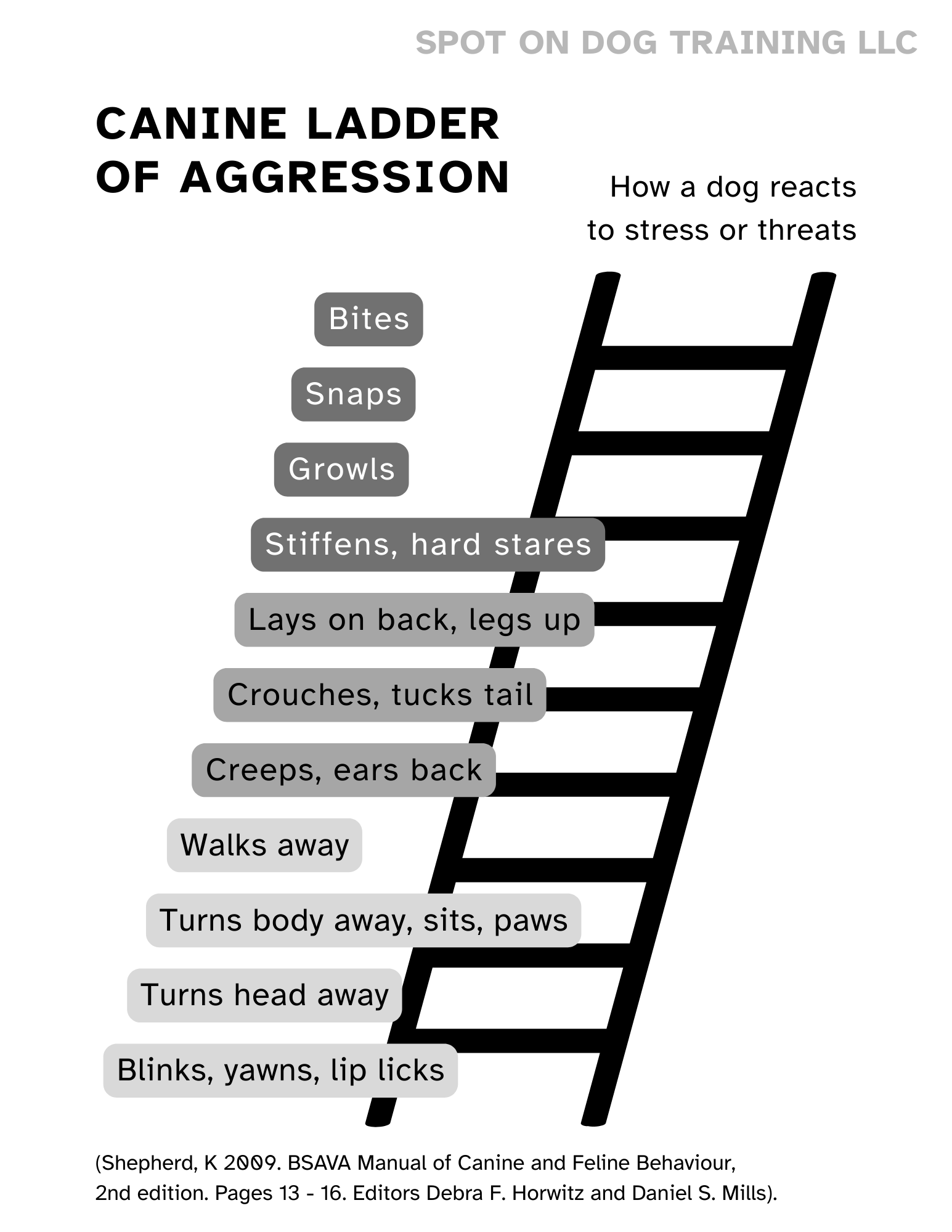
Title at the top of page: “The Canine Ladder of Aggression”
Page has a white background and everything else is greyscale. A light grey watermark at the very top right reads “SPOT ON DOG TRAINING LLC”
Black text heading on the right of the page “How a Dog Reacts to Stress or Threats” above a simple, black graphic of a ladder.
There is a text box aligned at the left side of each rung on the ladder. The ladder leans from the bottom left to the top right. The bottom four rungs’ textboxes have a light grey background with black text. They read: “Blinks, yawns, lip licks,” “Turns head away,” “Turns body away, sits, paws,” “Walks away.”
The middle three textboxes have a grey background with black text. They read: “Creeps, ears back,” “Crouches, tucks tail,” “Lays on back, legs up.”
Finally, the top four textboxes have a dark grey background with white text. They read: “Stiffens, hard stares,” “Growls,” “Snaps,” “Bites.”
The citation “(Shepherd, K 2009. BSAVA Manual of Canine and Feline Behaviour, 2nd edition. Pages 13-16. Editors Debra F. Horwitz and Daniel S. Mills).” is printed in smaller text at the bottom of the page.