Recall Tips
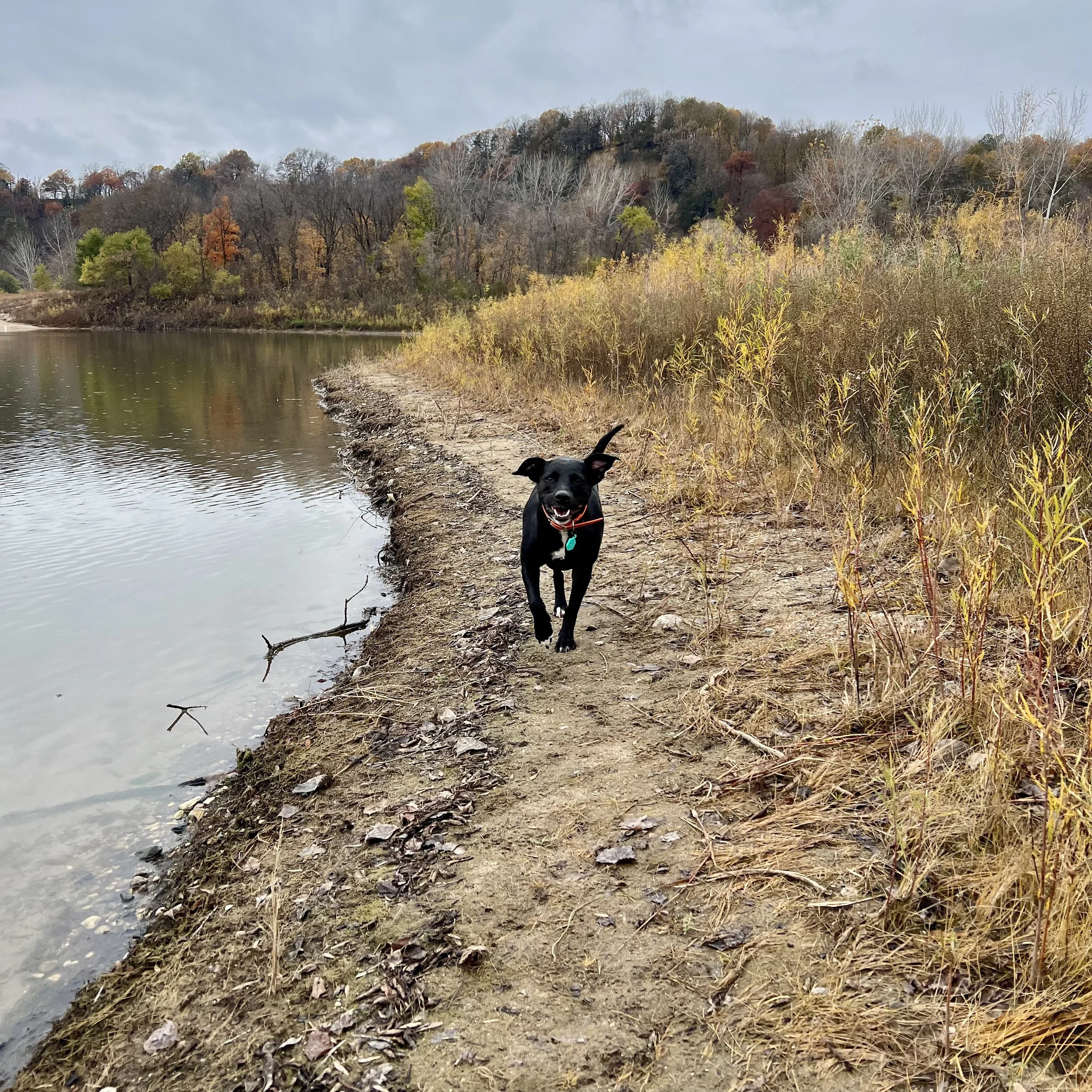
A medium-sized black dog runs down the beach of a river, toward the camera, mouth open.
Teaching your dog to come when called, or recall, is a matter of safety and a commonly requested skill. Many people want to train their dog to recall to reduce the risk of letting their dog spend time off-leash.
But let me be clear: spending time off-leash does not have to be the be-all and end-all goal for every dog! For dogs with a strong desire to chase and hunt critters, who are recovering from injury, are dog- or human-selective, are prone to eating unsafe items, etc., time off-leash can pose more risk (and frustration) than reward!
A long line (15-50-foot leash) is a smart way to reduce risk while still giving your dog plenty of freedom of movement. Long lines are better for dogs’ bodies, for meeting their needs, and for preventing leash tension! You can safely practice recalling with your dog on a long line, then drop the leash and let your dog drag it behind them as an intermediary step towards being off-leash.
In most cases, I recommend leashes made from ‘biothane.’ This material looks and feels similar to leather, but it’s lightweight, waterproof, stink-proof, and antimicrobial. Most biothane leash makers offer customization of width (⅜, ½, ¾ inches), color choices, and extras like a traffic handle (an additional handle closer to your dog), hands-free capabilities, scissor/trigger snaps, auto-locking carabiners, and two-color options.
My favorite makers are at High Tail Hikes. HTH is a small, women-owned business that prioritizes working with force-free dog professionals and giving back to their community- especially community shelters.
If you’re interested, I have a $10 off referral code for High Tail Hikes.
-
Bertie and I are here to show you how to make handling a long line easier. Today she’s got her 30-foot leash on. This leash is made out of the material Biothane, which is waterproof and stink-proof, which is nice for when we’re dragging lines on the ground sometimes. I like these nice locking carabiner connections because Bertie likes to roll a lot, and sometimes her leash might come unclipped that way. Just gives me a little extra sense of security.
I think a lot of folks get real intimidated when I ask them to try using a longer leash. But the important thing to note is that I’m not giving her all 30 feet of the leash the entire time we’re walking. I am reeling it in and out as we’re going along together. So she’s typically not all 30 feet away from me, but if she wants to walk up further, I can give her that room to do so.
Flexi leashes can be appropriate in some circumstances. I’m not hard and fast against them, but typically I prefer this because it’s easier actually for me to reel in. If shes’s, you know, pulling against me I can literally walk up her line like this to get her in closer. Whereas with an adjustable leash- could be pretty hard to get her back in.
The end of the leash, my leash handle, I don’t have it over my wrist like this. I have it on my finger, over my finger, so I can just kind of keep adding to this figure 8 coil and letting it go. If I wanted to keep her shorter and closer to me, I could reel her in to the length I want. And then in this hand [leash anchor hand] I’m going to put on a leash lock grip, which is where the last bit of leash is. I’m going to make a loop. I can put it either over my pointer finger or my thumb, and I can lock it on that way. I just take the end of the leash and fold it over my thumb on top of my bundle [of coiled leash].
Now I’ve got this locked on right here and she has only got, you know, effectively a 5-foot leash. And I can very easily then just let it go and continue letting out the line as she, you know, goes to sniff where she pleases and reeling it in as she pauses and comes back to check in with me.
-
Lily, a white femme person with long braided red hair, wears a safari hat and hiking clothes as they walk their dog on a trail. Their dog, Bertie, is a medium-to-small sized black pit bull mix, wearing a minimal black/purple harness attached to a 30-foot long, sage colored leash. They walk down a wide trail through some woods in the early spring. The landscape is still primarily brown and scruffy, but the sun is shining. The camera follows behind and beside Lily as they walk Bertie.
Lily talks to the camera, describing how to safely and easily handle a fixed-length long line. They are continuously reeling the leash length in and letting it out according to how far Bertie wanders. They have the trail to themselves and Bertie is following her nose and pausing to sniff, taking advantage of the extra room to roam. She occasionally stops to check in with Lily, at which point Lily usually stops to grab and feed her a treat.
When Lily tells the camera that they like a locking carabiner leash attachment because Bertie likes to roll a lot, the video cuts to a clip of her rolling on her back and wiggling on the side of the trail.
They continue walking along as Lily shows how they coil the leash in a figure 8 pattern (rather than a standard loop, which can cause finger injuries). They keep the leash handle looped over their left open palm (not wrist) and add the extra leash length to that hand with their right hand, in a figure 8 bundle.
Lily then describes how to use a ‘leash lock grip.’ They reel the leash into their desired length, five feet in this example, and then fold the last bit of leash outside their figure 8 bundle over their thumb or pointer finger, before closing their fist around the entire bundle, locking the leash in place at five feet long.
Until you have years of successful recalls with your dog around many different distractions under your belt, keep your dog on a leash or long line to prevent them from going on joy rides and side quests.
The outdoors are full of unpredictable distractions, and there’s no such thing as a ‘bomb-proof’ recall! Every dog has the potential at any time to decide that something else is more interesting, or reinforcing, than you.
The more your recall cue goes unresponded to, the more your dog learns ‘that word means nothing to me.’ Instead of punishing your dog for not knowing a skill you haven’t taught well enough, humble yourself and use a leash. Bringing a dog into your home is a big decision, and with that comes the responsibility to learn safe leash handling.
Allowing your dog off-leash requires risk assessment on your part. Set your dog up for success, not failure! Choose low-distraction environments to practice in and have safety measures in place, like a drag line and ridiculously high-value food reinforcement.
If you’ve been unsuccessfully using the word “come!” as your recall cue, consider choosing a different cue to reteach from scratch. Choose a consonant-heavy, punchy word that doesn’t come up often. For example, my dogs’ emergency recall* cue is “Junco!”
To teach your animal to come when called (a recall):
Begin practicing indoors in a familiar environment (home!) Prepare your treats, but keep them out of your dog’s sight.
- Make sure your dog LOVES the treats you use. Because a recall is a matter of safety for me, and I want my dogs to come flying at me every time I call them, I use high-value treats to reinforce every recall.
- Sneakily put your treat bag behind your back, or rely on getting treats from a nearby jar after you mark.
- Make sure your dog LOVES the treats you use. Because a recall is a matter of safety for me, and I want my dogs to come flying at me every time I call them, I use high-value treats to reinforce every recall.
Choose your moment wisely! If your dog is actively engaged in an activity, don’t call them to come until they disengage.
- By waiting until your dog disengages from whatever they’re doing, we’re setting them up for a successful recall rather than one they don’t acknowledge. We want successful recalls to FAR outweigh failed ones!
- Don’t use your recall cue unless you're willing to bet $40 that your dog will actually come. Overused cues that go unresponded to will grow weaker and weaker!
- Never use your recall cue to get your dog to come to something unpleasant, as this will poison the cue and make them less likely to come when called.
- For example, if your dog is avoidant and afraid of their harness or taking baths, don’t call “come!” and then put them in their harness or the tub; this will likely punish the response.
- Instead, find your dog and get them to do it if you need to for something they aren’t fond of.
- For example, if your dog is avoidant and afraid of their harness or taking baths, don’t call “come!” and then put them in their harness or the tub; this will likely punish the response.
- By waiting until your dog disengages from whatever they’re doing, we’re setting them up for a successful recall rather than one they don’t acknowledge. We want successful recalls to FAR outweigh failed ones!
- Eventually, we would like our dog to come when called mid-chase after a critter, but when we are first training this cue, that’s an unrealistic expectation.
- With your dog just a few feet away from you, cheerfully call, “(Your dog’s name), (Your recall cue)!” We’re trying to entice your dog to come to you, so avoid falling into an angry or frustrated tone.
The moment your dog turns to face you, or reorients towards you, mark (a click or “yes!”) to let your dog know that's the behavior you like, and then feed them right by your body.
- Specifically mark the moment your dog turns back towards you because disengaging from what they’re doing is the hardest part of a recall! If we wait until our dog is right beside us to mark, we’d likely lose their attention before they reach us.
- By using your marker early, you let your dog know “Yes, you’re doing the right thing! Treats are coming!”
- Remember, praise is different than your marker.
- Many of us find ourselves unconsciously repeating 'come' as we call our dog. If this is you, try repeating praise the whole time instead; "Nice job! Wow! Look at you go!!"
- Remember, praise is different than your marker.
- Specifically mark the moment your dog turns back towards you because disengaging from what they’re doing is the hardest part of a recall! If we wait until our dog is right beside us to mark, we’d likely lose their attention before they reach us.
Feed your dog right beside your body. Where you feed them will be where they learn to come to.
- Avoid reaching an arm’s length out to meet and then feed your dog. Then you’ll have a dog who’ll learn to come to an arm’s length away from you!
Whenever possible, immediately release your dog after a recall so they can resume having fun after getting their treat.
- We don’t want every time we call a dog to end their fun exploring outside, so letting them go right back to whatever they were doing is another great way to strengthen their recall.
Troubleshooting:
If your dog does not immediately turn and reorient towards you when you call them, wait a moment (this applies to any cue!) They might need a second to process. Avoid repeating the cue (“Randall, come! Come here, Randall! Randall, come on!”). Your dog will learn either a) to tune out all those words, or b) that the cue is “come, come, come here, come” instead of “come.”
If your dog is still hesitating, try turning and jogging a few steps away.
If your dog has still not turned to face you, try making rapid, repeated noises.
Instead of repeating yourself, try making some kissing or tongue-clicking noises, clapping or patting your legs, or even using a squeaker from a squeaky toy!
The moment you get your dog’s attention, mark and then feed handsomely.
What is an *emergency recall?
An emergency recall is to be used in real life only for actual emergencies. Choose a novel cue and pair it with super-enticing, high-value treats, delivered with excitement.
Novelty increases value, so I rotate rewards based on what leftovers I have in my fridge.
Some creative, high-value ‘treats’ I’ve used are grilled cheese sandwiches, plain cheeseburgers, pizza, quesadillas, chicken sandwiches, and breakfast sandwiches (think gas-station hot & ready food), all cut into half-inch-or-so squares.
Practice your emergency recall just once or twice a week and only when you’d bet $100 that your dog will come (absolutely no practice around distractions for months).
Practicing this emergency recall only occasionally can make your cue especially exciting for your dog!
For example, my dogs only hear “Junco!” once a week, so they’re really excited when they finally get to hear the cue.
There is a lot of nuance involved in training a dog to come when called. Way more than I can fit here! If you’re still struggling, don’t abandon hope! Book a training session so I can help you train your dog to recall with joy.