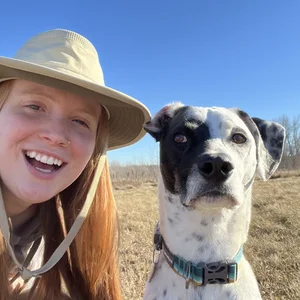
The Look At That (LAT) Pattern Game
To help a dog learn to respond more neutrally to distractions, we can teach them the Look At That Pattern Game (LAT). When your dog notices a distraction (like a person/dog/bicycle/etc), mark (say "yes" or click) the moment your dog clocks it, and then feed them a treat as they watch. Your dog does not need to look back at you for you to give them the treat.
Use distance to your advantage when practicing LAT.
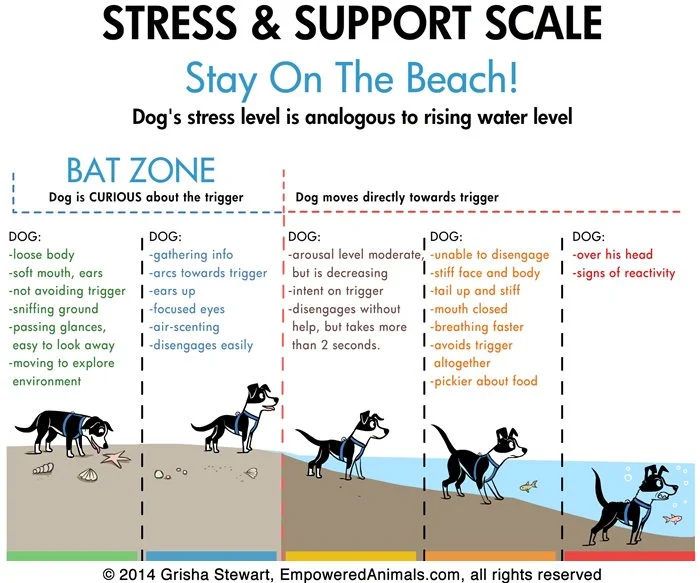
We want to keep your dog in the BAT Zone, as shown in the graphic below, or below threshold, where they’re curious about the distraction, but still able to disengage easily.
Reference this Dog Body Language post for extra clarification on thresholds.
-
A horizontally oriented infographic on a white background is titled “STRESS & SUPPORT SCALE” with a subtitle “Stay On The Beach!” directly below it. “Dog’s stress level is analogous to rising water level” is written below the subtitle.
The graphic is divided into five vertical columns with dotted lines. The first two columns are under the subheading “BAT ZONE. Dog is CURIOUS about the trigger. The last three columns are below a subheading “Dog moves directly towards trigger.”
Column one shows a black and white cartoon dog looking at shells on the beach at the bottom of the page. The text above reads: “DOG: -loose body, -soft mouth, ears, -not avoiding trigger, -sniffing ground, - passing glances, easy to look away, - moving to explore environment”
Column two shows the same cartoon dog standing on the beach with it’s mouth open looking ahead. The text above the dog reads: “DOG: -gathering info, -arcs towards trigger, - ears up, -focused eyes, - air-scenting, -disengages easily”
Column three shows the cartoon dog standing more tensely, looking ahead. The dog’s legs are drawn below the water. The text above the dog reads: “DOG: -arousal level moderate, but is decreasing, -intent on trigger, - disengages without help, but takes more than two seconds.”
Column four shows the dog standing somewhat crouched, with their tail held high, looking ahead. The dog is further underwater, but their head and tail remain above water. The text above the dog reads: “DOG: -unable to disengage, -stiff face and body, - tail up and stiff, -mouth closed, -breathing faster, -avoids trigger altogether, -pickier about food”
Column five shows the dog standing completely underwater, with their hackles up and teeth bared. The text above the dog reads: “DOG: -over his head, -signs of reactivity”
The bottom of the page shows a copyright; “2014 Grisha Stewart, EmpoweredAnimals.com, all rights reserved.”
Remember, our goal is that you are far enough away that your dog can perceive the distraction without overreacting. This way, we can mark and treat repeatedly for simply looking at the distraction. This training should look boring if we are doing it right!
To put it briefly, the LAT pattern is: distraction pops up, you mark the moment, and then feed your dog a treat.
For example: your dog sees a stranger = you mark/treat, sees a dog = mark/treat, sees a car drive by = mark/treat, hears dogs barking = mark/treat, perceives any distraction at all = mark/treat, etc.
I think of ‘distractions’ as any new stimuli in the environment that a dog can perceive. I think of ‘triggers’ as the most challenging distractions for an individual dog.
For my dog Randall, a tractor in the field next door is a distraction, while a dog walking past our house is a trigger.
Try to keep your treat delivery hand empty and frozen, in your pocket, planted on your leg, or behind your back until after you've given your marker. Once you’ve marked, then you should reach for a treat.
This is what I mean by ‘mark and then treat.’
Do your best to avoid adding tension to your dog’s leash when they see something (hiking it up, pulling them in closer, or locking it). This can often escalate a reaction! Try to stay at or get to a distance where you can keep the leash slack and trust your dog.
If you’re in a tight spot and your dog’s already reacting, that's a different story, and I expect leash tension.
I want to be sure you aren't adding tension to the leash before your dog starts reacting.
Even if your dog is reacting to something and pulling or vocalizing, I still want you to try to feed them. Strong reactions come from strong emotions, and we can't reinforce emotions. We’re not reinforcing the reaction; we’re conditioning your dog to expect a treat every single time they see their triggers.
Here’s how I recommend responding when a dog is already pulling/overreacting:
First, try to get a handful of high-value, smelly treats on your dog’s nose and check if they’ll eat. You may need to ‘walk up’ their leash, reach over their head, and literally put the treats on their nose so they can smell them and eat.
Do your best to match the treat value to the task at hand. When you are working around triggers, be sure to have extra special treats to stack the odds in your favor, even if your dog would eat anything.
If your dog is ever not taking treats, that’s a strong indication they are over threshold. When a dog is over the threshold, we should increase the distance between them and the trigger. Do your best to maintain further distance in the future!
At the same time, comfort and reassure your dog as you try to walk them farther away from the trigger, getting more distance.
Once you are far enough away that your dog begins to show glimpses of disengagement, scatter several small treats in the grass to help you both take a second to decompress a bit.
-
[Unspoken text comments and gifs are represented here in italics and brackets as this sentence is.]
The Look At That pattern game, or LAT for short, [the letters LAT expand on the screen next to Lily’s head] is a straightforward way to teach a dog to cope with distractions [a gif of a squirrel appears on Lily’s right shoulder and a gif of a Shiba Inu dog appears on their left shoulder] more calmly.
The LAT pattern goes: dog notices a distraction [a small overlay clip appears showing Lily’s dog notice something], handler marks the moment [another small overlay video clip appears showing Lily marking “yes!” as the dog notices], then delivers a treat [a final small overlay clip appears showing Lily tossing a treat to the dog].
Repeat this ‘distraction-mark-treat’ pattern [the words ‘distraction’, ‘mark,’ and then ‘treat’ fade onto the screen as Lily says them and then expand] for as long as your dog remains aware of the trigger [a gif of a dog appears and they dramatically look at the camera].
Once you’ve taught a dog the LAT pattern [the same ‘distraction, mark, treat’ words appear and expand as they did before], we can think of them noticing distractions as them pointing [a gif of Grover (from Sesame Street) laughing and pointing] them out to you. And when your dog points [same Grover gif] out a trigger they’ve noticed, that’s YOUR cue to mark. [The same small overlay clip of Lily marking “Yes” from before appears at the bottom of the screen; this time with a camera shutter capturing over the clip.]
When a roofer showed up at our home unexpectedly, right as we were heading out for a walk, LAT helped us all stay below threshold by assigning clear tasks to everyone, as the stranger moved about. [The main clip of Lily talking becomes a small overlay box in the top left of the screen. The main screen clip then shows Lily playing LAT with their dog.]
I’m focusing on my white dog, Randall, who has strong feelings towards strangers. Randall absolutely had words for the roofer when they first showed up, just about 20 feet away from us. So the first thing that I did was usher my dogs across the driveway to give us more space. Using distance to your advantage is critical to success.
Here, Randall can actually see the stranger without overreacting, enabling more productive learning.
When practiced below threshold, LAT builds a longer learning history in Randall’s brain that strangers are no big deal; they predict loads of extra good treats.
We’ve made LAT a normal part of being around distractions for years now, and it shows. Randall nailed it.
I’m super proud of how he coped with an unfamiliar man slowly walking the perimeter of our home. With consistent practice, LAT can help your dog stay calmer in the presence of distractions, too.
-
Lily, a white femme person with long, straight red hair, sits on an olive colored chair. They wear a brown “SPOT ON DOG TRAINING” t-shirt. This first part of the video shows Lily sitting inside, explaining the Look At That (LAT) game. Various text and gifs pop onto the screen as Lily speaks (dictated on the transcript!). Clips of Lily practicing LAT with their dog, Randall, appear overlaid as Lily describes the LAT pattern.
The main screen video then becomes the full clip of Lily practicing LAT with Randall. Lily’s talking head becomes a small overlay in the top left corner of the screen. Lily narrates the now full-screen video of them and Randall playing LAT. Randall is a medium-sized white pit bull mix with black spots and freckles. He wears a neon orange harness and is clipped to a 15-foot, periwinkle-colored leash. Lily is wearing a safari hat, sunglasses, shorts and a t-shirt, and is also holding an additional 12-foot long leash that’s attached to their medium, black dog, Bertie.
They all stand together on a concrete pad outside a shop on their property. Randall looks off screen, at a stranger and their truck parked in our driveway (the camera eventually pans to show the stranger and truck). Lily scatters treats in some leaves to keep Bertie busy out of the way; she isn’t overly concerned about the stranger.
Each time that Randall looks at or in the direction of the stranger, Lily calls “yes!'“ then grabs a treat from the pouch they wear on their waist, and then tosses the treat to Randall.
The rest of this description is coming soon! Please email if needed.