the Ping Pong Pattern Game
Lily demonstrates the ping pong training game with three different dogs. Full video description and transcript below.
‘Ping Pong’ is a simple and versatile pattern game. You might want to play this game with your dog if you want a joyful recall, more check-ins from your dog, or a safe pattern to help get your dog out of sticky situations. Once taught, Ping Pong can function as a familiar, predictable game for your pet to more easily remember- even when they are feeling excited or unsure about something.
To play the training game Ping Pong, all you need are treats and some space. If you’re interested, check out my treat recommendations. Typically we want treats to be small so we can safely use a high rate of reinforcement. However, when first teaching this pattern it can be helpful to use treats with a bit of weight and size to them. It’s also helpful to introduce the game on a flat surface like a low pile rug, cement/concrete, or a hardwood floor. Keep your tosses somewhere between 3-6ft out initially.
Do your best to underhand toss or “bowl” your treats. Practicing this game will help you get better, too! Ideally, we want predictable landing spots and bounces, especially at first. Carefully chosen treats and surfaces can make it easier for us to toss with accuracy and easier for our learner to find their food promptly. We are looking for fluent, moderate paced repetitions. Getting to chase treats back and forth is part of what makes this fun for our dogs!
To summarize, the steps of Ping Pong are as follows:
Carefully toss a treat to your side, just a few feet away.
Allow your dog to chase and eat the treat.
Mark (click or use a different marker) as your dog begins to turn their body back toward you.
Deliver their treat by tossing it out a few feet to your opposite side.
Repeat! As you and your dog get better at this game, you can try farther tosses, different treats (or kibble), and slowly fading in distractions while you play.
The first criteria I will mark, or click, is the moment the animal’s body starts to turn back toward me. You may also choose to use a verbal marker like “yes!” or otherwise. Your dog disengaging from what they’re doing is the hardest & the first stage of teaching this game. Once my learner can predictably stay engaged in the pattern at this stage, then I can raise my criteria. Next stage, I’d mark once their head reorients towards mine. Finally, with dogs that are already offering eye contact, I will mark when the make eye contact with me. Please note, I won’t ever force a dog to make eye contact with me, as this can be perceived as distressing in canine body language.
Keep training games short (two minutes or less in a row) to maintain engagement and minimize errors. Pay close attention to how your dog is moving their body as you play. If your dog is stumbling, tripping or having to hit the brakes when they overshoot their treat, that’s your cue to slow the game down. Sharp direction changes and abrupt starting/stopping can cause micro traumas and injuries over time. Playing on a surface with high traction, like a rug, dry grass, concrete, etc., can also help avoid slipping.
At the end of every training session, I will offer my learner a transitional activity. These should be decompressing for a dog and help them to learn that the game is over now. Good transition activities involve sniffing, chewing, licking, and/or shredding. Some examples could be: a treat scatter in a snuffle mat or in the grass, a mini frozen snack, shredding a cardboard box, a chew or putting some food in a different puzzle toy.
-
Lily, a white femme person with red hair pulled back in a clip, stands in front of two side-by-side, closed closed garage doors. They wear sunglasses, a green hoodie, brown yoga pants, and big green rainboots.
First they have a medium-sized, black, short-haired mixed breed on their neon orange 12 foot long line. Bertie, the black dog, is a pit bull mix and wears a wide neon orange collar. Bertie stands still, watching Lily while they talk. White text captions appear at the top of the screen with a black background. At timestamp 22 seconds, they play the ‘ping pong’ pattern game until timestamp 1:00. Every time Lily clicks the clicker, the caption “*click” in black text appears over a neon yellow background.
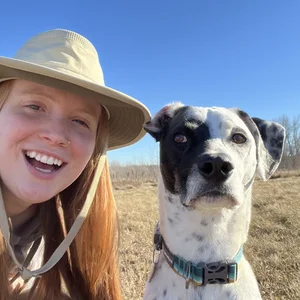
At timestamp 1:05 Lily walks on screen with Randall, a medium-sized mixed breed dog. He is also a pit bull mix and has white, short fur with black spots and patches. He is very excited and frantic with his movements at first. His movements become calmer and more controlled as they play ‘ping pong.’ Starting at timestamp 1:17 until timestamp 2:09.
Finally, Lily kneels down while talking next to a German Shepherd Dog named ‘Maybe.’ Maybe pants and happily leans into Lily while getting scritches. At timestamp 2:30 Maybe walks off screen as Lily continues talking and then returns to their side at timestamp 2:50 to ask for more pets. At timestamp 3:07 they play ‘ping pong’ and continue until the end of the video.
-
Okay Bertie, let’s do Ping Pong. I’m going to do my absolute best when tossing treats, when we’re working on leash, to not toss it without her- out of her reach. I wanna make sure she can actually get it with the length of leash she has on. That’s why I like practicing with a longer line. A hands-free leash is also really nice to practice in so you can be more aware of your body.
I’m going to start by tossing a treat out- click- and mark when she reorients towards me- click- and then toss a treat in the other direction. Click- You’ll notice I’m not even necessarily waiting for eye contact. I’m just marking- click- her body turning back towards me as my first criteria. Good girl. Click- Especially if we were working in, like a really distracting- click-environment, that turn back is the first thing I’m going to click- click- because that’s the hardest part. Click- Good job. Good job. Okay, take a break.So, Randall can get really into games. And that’s, you know, I like the excitement, but he has arthritis and IVDD and so I don’t want him to aggravate his joints. So I’m gonna try really hard to make sure that he is moving his body safely. Click- So, for him, with Ping Pong, I’m going to start pretty close to my body. Like I’m not tossing- click- these out super far… Click- ‘Cause I want to be able to keep the game moving fast- click- and also not too chaotic. Click- click- click- click- click-
This is our foster dog, Maybe. We’ve had her for about two weeks now. You should adopt her. But she, you know, has history that, first of all, a lot of its unknown. Second of all, we know that she’s had kind of a rough history. And I strongly suspect that she is in pain, because of a lot of reasons. So I’m working with the rescue to try and get on some pain meds and that addressed.
But that’s just another reason why I will never force a dog to work with me. I will always let them leave a session and I will never use any sort of aversive training tools or techniques to force her to do it because she’s in pain and I do not need to add to it. I do not want to. I want to be a predictor of good, fun things. So we’re building up our attention.
Are you ready? You wanna play? Ready? Click- click- … click- Good! Sometimes she needs a little extra time. Click- I’m still just going to wait for her to reorient her head towards mine click- and then I’m using the treat kind of as a lure to show her where I’m going to toss it. But she’s stuck in this for, I mean, this is a lot of reps of giving me her attention. I’m really impressed. Good job, Maybe!