Teaching Touch
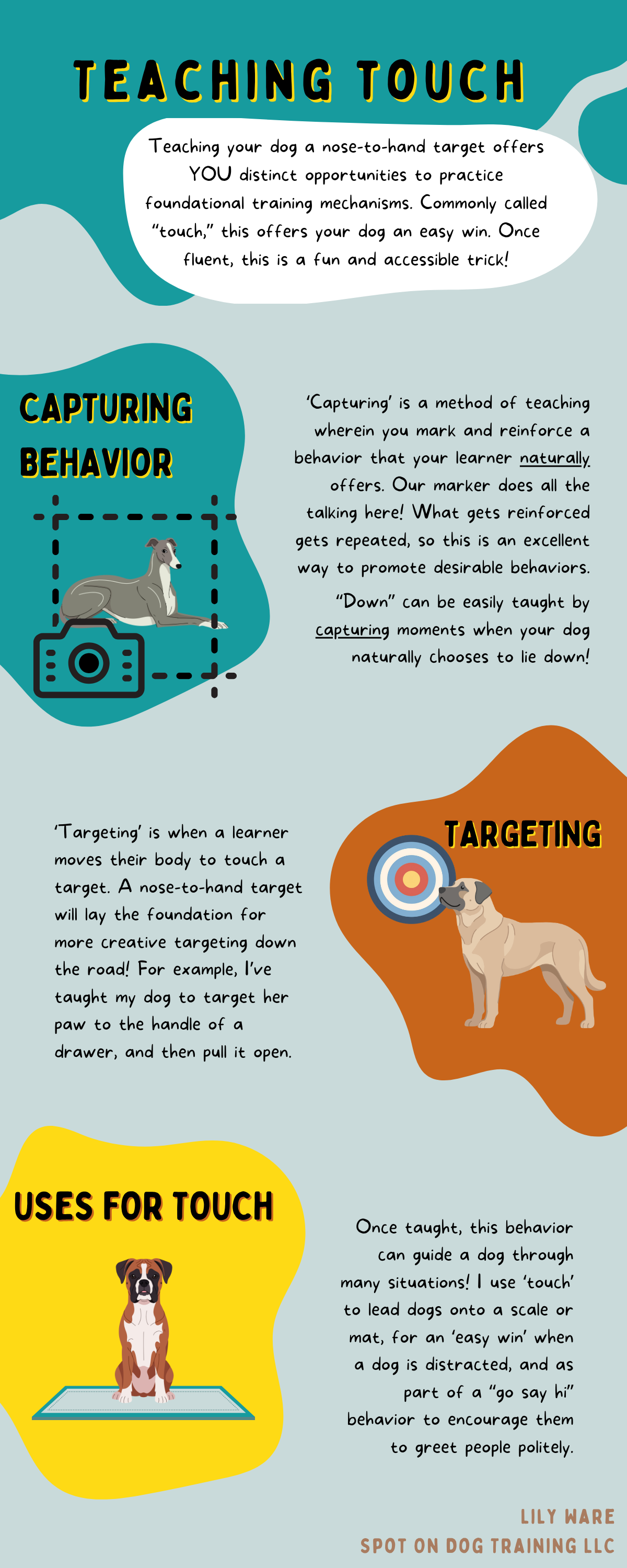
Infographic page one. Full ID and text below.
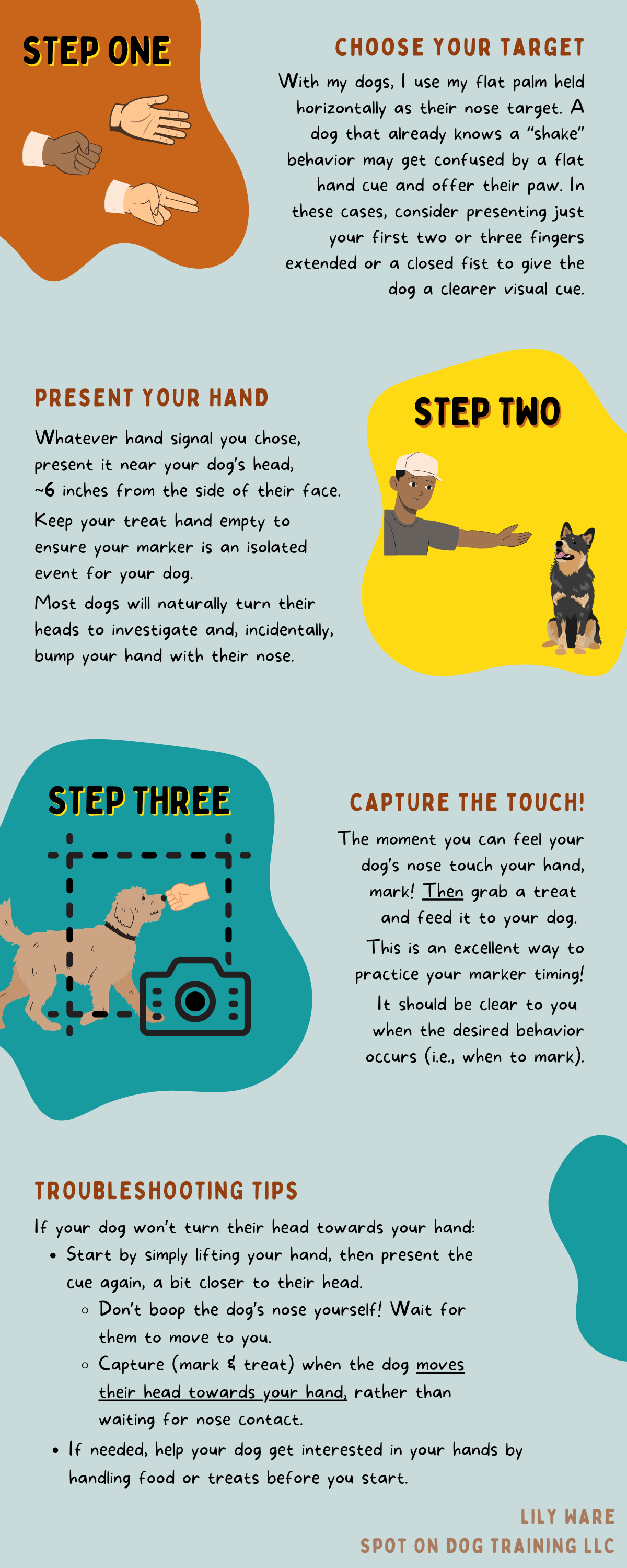
Infographic page two. Full ID and text below.
-
A light blue infographic with the title “TEACHING TOUCH” at the top of the page. Beneath the title is a white bubble of text (see full text below). Three large, colorful bubbles contain headings. Beside each bubble is a larger block of text explaining. The bubble and text alternate left and right as you go down the page. The first bubble is teal and features a greyhound laying down. A camera’s focus outline is overlaid the greyhound. Next bubble is orange and shows a mastiff standing facing a bullseye target. The bottom bubble is yellow and features a boxer sitting on a blue mat.
-
Follows the same format of colorful bubbles, alternating sides. The first bubble is orange and shows three floating hands. Two hands have light skin- one is a flat hand and the other has two fingers extended. The third hand has dark skin and is a closed fist. The next bubble is yellow and shows a dark skinned man extending his flat hand toward a cattle dog. The bottom bubble is teal and shows a doodle-dog touching a light-skinned closed fist. A camera focus outline is over the dog touching the hand. At the bottom of the page is a larger body of text.
-
TEACHING TOUCH
Teaching your dog a nose-to-hand target offers YOU distinct opportunities to practice foundational training mechanisms. Commonly called “touch,” this offers your dog an easy win. Once fluent, this is a fun and accessible trick!CAPTURING BEHAVIOR
‘Capturing’ is a method of teaching wherein you mark and reinforce a behavior that your learner naturally offers. Our marker does all the talking here! What gets reinforced gets repeated, so this is an excellent way to promote desirable behaviors.
“Down” can be easily taught by capturing moments when your dog naturally chooses to lie down!TARGETING
‘Targeting’ is when a learner moves their body to touch a target. A nose-to-hand target will lay the foundation for more creative targeting down the road! For example, I’ve taught my dog to target her paw to the handle of a drawer, and then pull it open.USES FOR TOUCH
Once taught, this behavior can guide a dog through many situations! I use ‘touch’ to lead dogs onto a scale or mat, for an ‘easy win’ when a dog is distracted, and as part of a “go say hi” behavior to encourage them to greet people politely.STEP ONE
CHOOSE YOUR TARGET
With my dogs, I use my flat palm held horizontally as their nose target. A dog that already knows a “shake” behavior may get confused by a flat hand cue and offer their paw. In these cases, consider presenting just your first two or three fingers extended or a closed fist to give the dog a clearer visual cue.STEP TWO
PRESENT YOUR HAND
Whatever hand signal you chose, present it near your dog’s head, ~6 inches from the side of their face.
Keep your treat hand empty to ensure your marker is an isolated event for your dog.
Most dogs will naturally turn their heads to investigate and, incidentally, bump your hand with their nose.STEP THREE
CAPTURE THE TOUCH!
The moment you can feel your dog’s nose touch your hand, mark! Then grab a treat and feed it to your dog.
This is an excellent way to practice your marker timing!
It should be clear to you when the desired behavior occurs (i.e., when to mark).TROUBLESHOOTING TIPS
If your dog won’t turn their head towards your hand:Start by simply lifting your hand, then present the cue again, a bit closer to their head.
Don’t boop the dog’s nose yourself! Wait for them to move to you.
Capture (mark & treat) when the dog moves their head towards your hand, rather than waiting for nose contact.
If needed, help your dog get interested in your hands by handling food or treats before you start.
Lily Ware, Spot On Dog Training LLC