Dog Food & Weight Management
⚠ Trigger Warning ⚠
At some point in the pet industry, you’ve probably heard someone describe pet obesity as an ‘epidemic.’ Many vets advise that keeping your dog trim is an ‘easy’ way to prevent and reduce pain. While excess weight is a proven concern, it’s rarely an easy change to make. A lot of the coarse discussion about pet weight reflects our larger human society’s deep fatphobia.
Ethical pet weight management deserves more thoughtful, informed consideration than just restricting meals.
Choosing what and how much to feed your dog can feel so complicated!
I remember wishing the vet would just tell us what to feed, but the truth is: every dog is an individual and will thrive on different recipes. Finding the best food for your dog will take some trial and error.
As a baseline, make sure the food you’re considering meets AAFCO nutritional requirements.
Look for an “AAFCO Statement” on the label, near the ingredient list.
I don’t care what kind of food (kibble, fresh/gently cooked, air-dried, etc.) you feed,* as long as your dog is eating it all, has regular fecal scores, and minimal stomach gurgling.
A dog’s stool is a quick health indicator that provides clear data. Tracking fecal scores over time can help you spot patterns and changes more easily.
*Research shows there are significant risks associated with feeding raw, uncooked foods to a dog. I generally recommend against feeding raw because much less risky, more carefully formulated foods are readily available.
As Cornell’s Vet School Canine Health Center writes,
“The bottom line is that we want you to know the full risks and benefits of what you feed your dog. Be sure to read labels carefully and reach out to your veterinarian if you have any concerns.”
If you have a special interest in canine nutrition, check out The Canine Health Nut website.
Linked is one article from Nikki: How to Choose a Dog Food.
How Much to Feed
When deciding how much food to feed your dog, focus on the recipe’s calorie content instead of the feeding chart recommendations.
The Dog Calorie Calculator spits out a recommended daily calorie intake for your dog, which is a great starting point.
Finding your dog’s ideal daily caloric intake as they grow and age will also take a bit of trial and error.
Body Condition Scoring
Learning to evaluate a dog’s Body Condition Score (BCS) is the most objective way to monitor their weight. A BCS is a rating of 1-9, and a score of 4-5 is ideal for most dogs.
You want to be able to feel a dog’s ribs along their sides easily, but you shouldn’t be able to count each rib from across the room.
Some people use a hand trick:
If my dog’s ribs feel similar to my knuckles when I make a fist, they are underweight.
Ideally, their ribs should feel like the bones of your fingers on the back of your flattened hand.
The heel of your palm illustrates how some bones are difficult to find and feel through the skin.
If your dog scores above 5 or below 4, carefully adjust their daily caloric intake as indicated. Ask your vet for guidance!
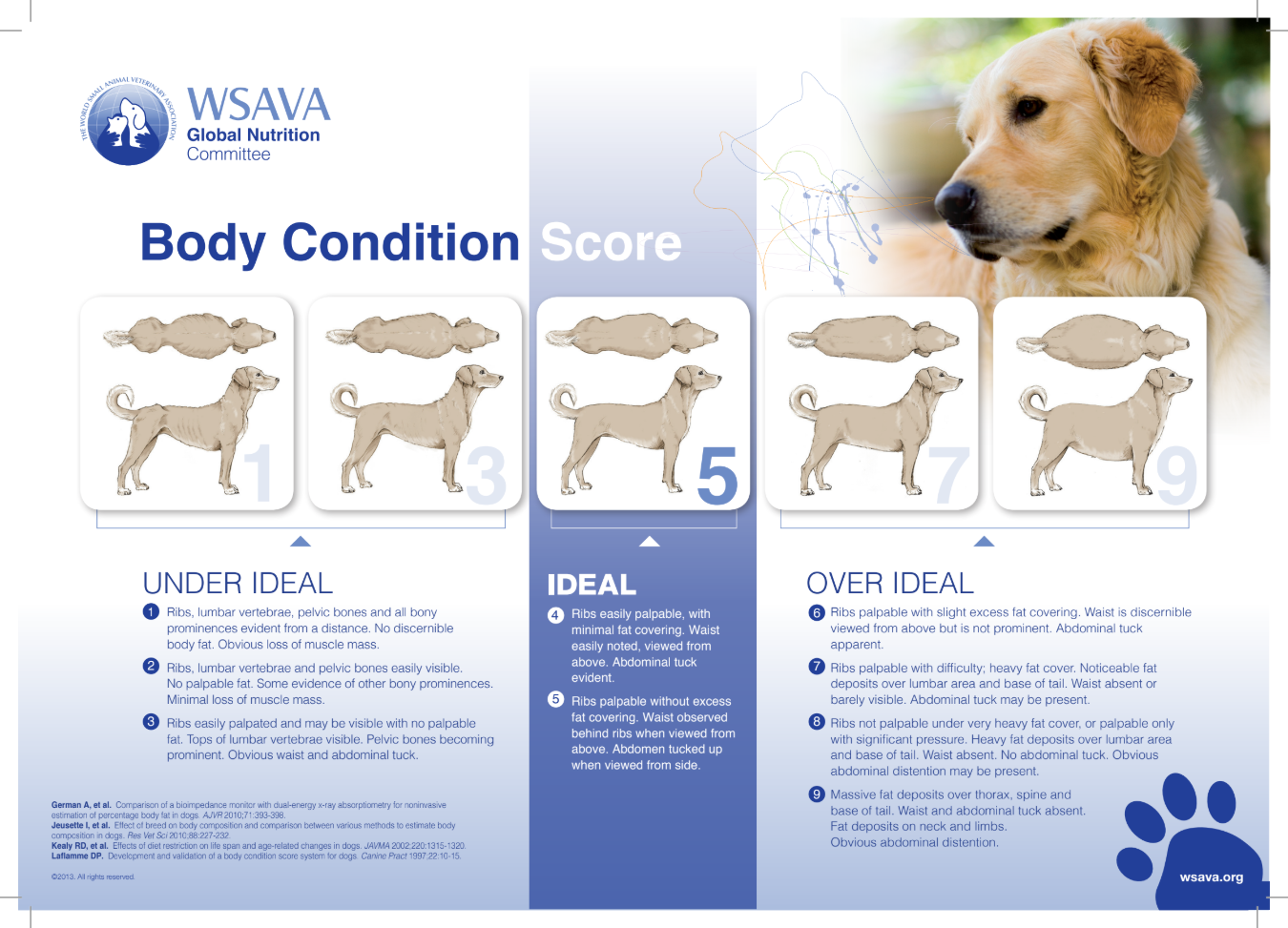
WSAVA Body Condition Score
-
A white poster with blue accents showing the WSAVA Body Condition Scoring system.
In the top left is the World Small Animal Veterinary Association (WSAVA) logo with the text “WSAVA, Global Nutrition Committee.”
The top right of the poster shows the head of a golden retriever.
Title: “Body Condition Score”
Five cards are shown across the middle of the poster, each showing two views of the same tan dog, seen standing from the side and top.
The heading “UNDER IDEAL” is below the first two cards. The leftmost card features a light blue “1” and the next card reads “3.” Below the heading are text descriptions for the scores 1, 2, and 3.
The heading “IDEAL” is below the center card which features the number “5.” Below the heading are the text descriptions for the scores 4 and 5.
The heading “OVER IDEAL” is below the last two cards. The first reads the number “7” and the rightmost card has the number “9.” Below this heading are the text descriptions for the scores 6, 7, 8, and 9.
The text descriptions of each score read as follows:
Ribs, lumbar vertebrae, pelvic bones and all bony prominences evident from a distance. No discernible body fat. Obvious loss of muscle mass.
Ribs, lumbar vertebrae and pelvic bones easily visible. No palpable fat. Some evidence of other bony prominences. Minimal loss of muscle mass.
Ribs easily palpated and may be visible with no palpable fat. Tops of lumbar vertebrae visible. Pelvic bones becoming prominent. Obvious waist and abdominal tuck.
Ribs easily palpable, with minimal fat covering. Waist easily noted, viewed from above. Abdominal tuck evident.
Ribs palpable without excess fat covering. Waist observed behind ribs when viewed from above. Abdomen tucked up when viewed from side.
Ribs palpable with slight excess fat covering. Waist is discernible viewed from above but is not prominent. Abdominal tuck apparent.
Ribs palpable with difficulty; heavy fat cover. Noticeable fat deposits over lumbar area and base of tail. Waist absent or barely visible. Abdominal tuck may be present.
Ribs not palpable under very heavy fat cover, or palpable only with significant pressure. Heavy fat deposits over lumbar area and base of tail. Waist absent. No abdominal tuck. Obvious abdominal distention may be present.
Massive fat deposits over thorax, spine and base of tail. Waist and abdominal tuck absent. Fat deposits on neck and limbs. Obvious abdominal distention.
Sources are cited in the bottom left of the page:
“German A, et al. Comparison of a bioimpedance monitor with dual-energy x-ray absorptiometry for noninvasive estimation of percentage body fat in dogs. AJVR 2010;71:393-398.
Jeusette I, et al. Effect of breed on body composition and comparison between various methods to estimate body composition in dogs. Res Vet Sci 2010;88:227-232.
Kealy RD, et al. Effects of diet restriction on life span and age-related changes in dogs. JAVMA 2002;220:1315-1320.
Laflamme DP. Development and validation of a body condition score system for dogs. Canine Pract 1997;22:10-15.
© 2013. All rights reserved.”In the bottom right of the page is a blue paw print with the text “wsava.org” inside.
Ethical Pet Weight Management
If you need to reduce your dog’s calorie intake, make small adjustments over time.
Consider the following questions, and ask for help when needed.
Where are the excess calories coming from?
Could you use lower-calorie, smaller training treats, or use a portion of their daily meals for training instead?
Administering daily meds in a pill pocket is one source of calories I have missed before.
I’m not advising against food sharing! I love and even recommend sharing food with most dogs.
‘Human food’ means nothing; food is food. Just be mindful of the size of the pieces. A piece just big enough for your dog to taste works (for training treats, too).
Why are those calories being fed?
Is your dog driving you up the wall unless you feed them? Evaluate and adjust how you meet their needs.
Does your dog need a steady stream of food to complete required grooming tasks? Will they flee or protest aggressively without constant treats? Consider a trial of pain medication to reduce discomfort while using less food.
Are non-food unmet needs being ineffectively met with food?
A dog might be amped because they’re missing ways to meet species-typical needs, like destruction, shredding, or scent tracking. A frozen lickable treat might keep them busy, but it won’t always address the needs driving unwanted behaviors.
Does the dog have adequate pain management to engage in a wide range of species-typical behaviors (like sniffing, chewing, shredding, and digging)? Is their weight actually limiting their ability to engage in those behaviors?
Does your dog not enjoy being outside, head for home quickly, or even refuse to walk or explore? This might mean your dog needs pain meds to meet their needs outside comfortably.
Exercise is only a small part of weight management and meeting a dog’s needs. Most dogs are trimmer in the warm months because their other needs are better met, not necessarily because they get more exercise.
Time to move and sniff freely outside matters more to me (and your dog) than the number of steps they take; this meets their needs better and reduces the need for additional food enrichment later.
Quality of movement (not strenuous, low-impact, unimpeded walking) is more important than quantity. Use a longer leash and an ‘H’ or ‘Y’-shaped harness for higher quality movement.
The conditions outside may change with the seasons, but your dog’s needs do not. This leads many of us to offer more kinds of food enrichment in the winter, and rightfully so! Don’t sweat small, cyclical weight changes through the seasons, as this is normal for all mammals.
Addressing the above can be inaccessible to some families, which is not an individual’s fault and reflects larger systemic issues. Submit an inquiry form to work with me if you need help ethically training your dog while also ethically managing their weight.